Monday, 21 December 2015

OUAN501 - Desire (7)

This lecture on the theory of desire was delivered by Simon Jones, with an emphasis on the theories of Sigmund Freud and Jacques Lacan.

Sigmund Freud was an Austrian neurologist and seen as the founder of psychoanalysis. Psychoanalysis is a clinical method for treating psychopathology through the conversation between a patient and a psychoanalyst. He established psycho-analysis in 1880s as a form of psycho-therapy, “the talking cure” treated “hysteria” patients – symptoms manifested from psychic traumas. The theory of desire lies in ideas of repression and the unconscious. Furthermore, infantile sexuality stages of psychosexual development. Tying in with this were were referred to the Oedipus complex, which is was one of the more unusual things I've been informed, so it was quite difficult to interpret it at first, but very interesting. Essentially, the Oedipus complex is the concept used to explain the emotions and ideas that the mind keeps in the unconscious, via something called dynamic repression, that concentrates upon a child's desire to have sexual relations with the parent of the opposite sex (i.e. males attracted to their mothers, and females attracted to their fathers). In addition to this, The "Oedipal complex" refers to the sexual relations and desire shared between a son and his mother and does not have to be reciprocated.

In Freudian theory, a child's identification with the same-sex parent is the successful resolution of the Oedipus complex. Successful resolution of the Oedipus complex is a psychological experience 'necessary for the development of a mature sexual role and identity'. Following this, Sigmund Freud suggested that boys and girls experience the complexes differently. Boys in a form of anxiety around the idea of castration, and girls in a form of penis envy. 'The unsuccessful resolution of the complexes might lead to neurosis, pedophilia, and homosexuality'. It was stated that, 'men and women who are fixated in the Oedipal and Electra stages of their psychosexual development might be considered "mother-fixated" and "father-fixated."' In adult life this can lead to a choice of a sexual partner who resembles one's parent. An example of this was mentioned in relation to school masters acting as substitute fathers, "We can now understand our relation to our schoolmasters. These men, not all of whom were in fact fathers themselves, became our substitute fathers. That was why, even though they were still quite young, they struck us as so mature and so unattainably adult. We transferred on to them the respect and expectations attaching to the omniscient father of our childhood, and we then began to treat them as we treated our fathers at home. We confronted them with the ambivalence that we had acquired in our own families and with its help we struggled with them as we had been in the habit of struggling with our fathers…"

The lecture also focused on the aspect of desire and its use in marketing, specifically with Marlboro cigarettes. Health concerns in relation to smoking cigarettes the 1950s sparked the rise of filter cigarettes. Philip Morris decided to reposition the Marlboro brand for the filter market. Originally thebrand was marketed as "Mild as May" to attract a heavily female audience, all at once gained a filter and became a man's cigarette. Following this, the marketing would no longer include phrases such as, "Ivory Tips to protect the lips" or "red beauty tips to match your lips and fingertips," Which it had done since the 1920's.

Previously, filter cigarettes as a whole were thought to be "sissy" or effeminate, lacking in flavor and meant for those who couldn't handle stronger tasting brands. When the Marlboro Man campaign was devised, Philip Morris worked to reverse this idea. The first 'Marlboro Men'to appear in advertisements were excessive in their masculinity. The models representing the brand ranged from cowboys and sailors to businessmen and academics. Something interesting and in common amongst the different models on the advertisements, is that they always featured a military-inspired tattoo on the back of their hand. The hand tattoo was discontinued in 1960 and the years that followed. Depsite this, the message Marlboro delivered, intertwined with masculinity was steady for decades after.

In terms of content I think this was one of my favourite lectures. Specifically, I found the psychological side of the lecture particularly interesting, encouraging me to carry on reading on the topic of classical Freduian theories.

OUAN501 - Panopticism - Institutions and Institutional Power (6)

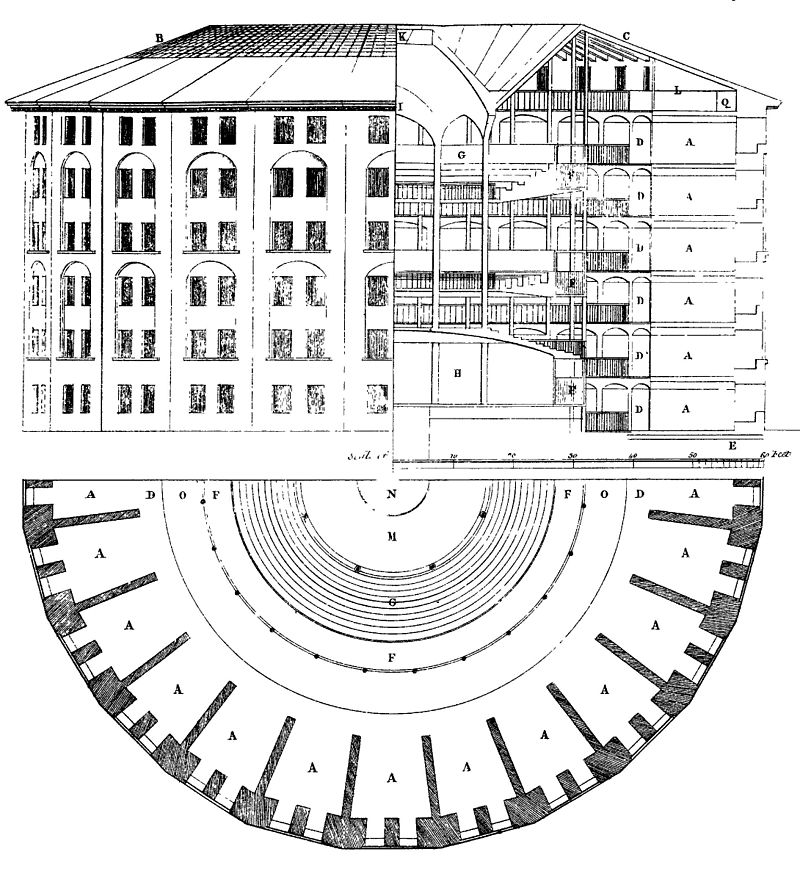
The lecture today on panopticism and institutional power was delivered by Richard. A lot of the lecture was focused on the theorist Michel Foucault, which I believe Richard has mentioned before. Foucault believed in knowledge, and knowledge as a form of power that could be applied. He thought that power has a relationship between people and because of this power could shape and control certain behaviour. This type of idea applied created the technique of 'Panopticism' which is seen in the physical form as a Panopticon. The Panopticon is a type of institutional building that designed by a social theorist and called Jeremy Bentham in the late 18th century. The idea behind the design of the Panopticon is to allow the inmates of an institution to be observed by a single watchman without the inmates being able to tell whether or not they are being watched. So the cells would be arranged in a circular fashion around a watchtower in the centre of them all known as an 'inspection house', which was blacked out so that you couldn't see into it from the position of the cell you were in. The inspection house housed a manager or staff of the institution. Although it is physically impossible for the single watchman that would have been on duty to observe all cells at once, the inmates in the cells cannot know if or when they are being watched means that if they want to avoid punishment the inmates must act as though they are watched at all times, effectively controlling their own behaviour throughout their stay in the prison. Bentham came up with the idea and thought that the basic plan of the circular outer ring, with the figurehead in the centre as being quite easily passed over to create institutions such as hospitals, schools, daycares, and asylums, but most of his efforts were assigned to developing it for a prison, and it is the prison which is most widely understood by the term. He also described the Panopticon as "a new mode of obtaining power of mind over mind, in a quantity hitherto without example', so he thought at the time that his design was the best at controlling the inmates and having the most amount of power over them, even through the fundamental process of having them kept in their cells. The process and design was so strong because for the use of a prison especially, it was an effective way of making sure the bad behaviour of the inmates was kept to a minimum, and there wasn't much interaction between the inmates themselves and the guards or management. The name, despite having roots in 'seeing' (opticon) is also a reference to 'Panoptes' from Greek mythology. He was a giant with lots of eyes, and seen to be a very effective watchman.

Foucault believed that the theory of panopticism was a metaphor for society, specifically how we are always being watched by those in power or by the people with authority, whether it be a teacher or a prison guard. He stated that "the Panopticon is a model of how modern society organises its knowledge, its power, its surveillance of bodies, its training of bodies". A negative side product of Bentham's design is the oppression of people. When control is taken from the hands of the inmates and passed to another, in this case the prison which acts as a form of societal power, then manipulation and exploitation can occur. There is also an issue regarding the privacy of the inmates and their rights in this respect. This issue can also be seen in a modern society, and is often talked about. Often we are unaware of the amount of surveillance we are subject to. For example, CCTV affects us and our behaviour in a similar way to the effect of the Panopticon on the inmates. Though we are told and in many ways we are the beneficiaries of it being put into place, we may act to some extent differently whilst knowing we are being watched. Another example that was given in the lecture of this was in an educational setting. Seats are placed in a way that makes it so the teacher or the person in power can see all of the people attending, and in turn can observe everyone present, this was even evident in the lecture we were sitting in at the time. The arrangement makes it so the people sitting at the front, closer to the person in power could feel more pressured than the people further away to make sure they don't do anything wrong. This is just one example of the theory in practice, the teacher essentially has more control and power based on the way the seats for the students to sit in are organised.

OUAN501 - Identity (5)

In the lecture today we looked at the topic of 'identity'. During the lecture we were shown how popular historical conceptions of identity have changed with time and through different circumstances. Also, stereotypes and to how we as a modern generation in a modern era perceive the state of 'identity'. Finally, how brands and advertising specifically try to challenge it through their use of fashion, design and other forms of visual communication. We also looked briefly into 'physiognomy', which is the assessment of someone's personality or character based on their appearance, this was really quite interesting to me because it's something we all do subconsciously and is almost built into us as a way of evaluating people and what we think of them without ever having spoken to them. This practice was accepted by ancient Greek philosophers but was revived and popularised by a man called Johann Kaspar Lavater from 1775 who was responsible for introducing the idea that this related to specific character traits rather than general types. Furthermore, Cesare Lombroso introduced the theory of anthropological criminology which states that criminal tenancies can be inherited and because of this people who are born criminals can be identified by looking at the physical traits they possess. A person who was born a criminal would have a certain physique, certain facial features, and a lot of tattoos were another feature that he saw as prominent to being a criminal, obviously you aren't born with these however. Though at the time they were conducted these were serious studies, if these were conducted today these would be classed as stereotyping and would hold no academic or scientific merit.

There is a big difference between the historical use of identity and how identity is viewed today, especially in the digital world we live in. We looked at the different phases of identity, these being Pre-modern, Modern and Post-modern. The pre-modern position on identity is one which suggest that personal identity is stable and heavily defined by long standing roles including things like marriage, the church and work whereas modern and post-modern views suggest that you are able to choose your identity and that it is constructed out of the discourses that are available to you. Identity was born when when ancient Greek philosophers introduced the idea of physiognomy. This was an idea that you could study the appearance of a person's face, and judge their personal characteristics or personality traits off these aspects. So, one example was that if your forehead was exactly parallel to your chin, you were a highly intellectual being or very intelligent. The way these traits were looked into however meant that if you held certain genetic traits in terms of your physical appearance it would mean that certain negative or positive attributes could be given to you based on the way you looked. This type of study continued to reappear throughout history but by today's standards it is unheard of, and we would class this type of labelling and allocating characteristics based on physical appearance stereotyping.

In a variety of different industries and practices today, the idea of a stereotype is challenged and we were given some examples of these in the lecture. For example, in fashion. Vivienne Westwood's 'Anglomania' collection used a range of opposing ideas in both the visual sense, using the collection and the ideas used through naming things. So, Tartan is mostly associated with Scotland, however her collection was called 'Anglomania' and using the word 'Anglo' suggests you're from England. This creates a separation in the stereotype of Tartan being used in Scotland and naming the collection after a place that isn't Scotland. In terms of the design industry, Jonathon Barnbrook created the 'Bastard' typeface in 1990. The way that the lettering is composed and the characteristics is possesses with a type of thick boldness resembles that of the Nazi propaganda typefaces that were used in the 1930's. There are also no curves in the typeface, and is quite simple in this sense - and due to the fact it is an exploration of 'blackletter', there is an association/stereotype of Nazi Germany and fascism. Another good example of this that we were shown during the lecture is Tracey Emin's "Everyone I Have Ever Slept With (1963-1995)". For this piece she created a tent that was lined with names of people she had slept with, and it is often misinterpreted as being the names of all of the sexual partners she has had. Without looking further into it the piece can easily be taken at face value, and because of the nature of who she is and what she does you would assume it's a piece to provoke people and allow them to think it has this meaning. Only a few of the names mentioned in the tent she are her past or current sexual partners and the rest are a collection of family and friends and people she had shared a bed with, or fallen asleep beside, leading to an interesting revelation to the audience.

OUAN501 - The Flipped Classroom (3)

This lecture was delivered by Richard on the subject of 'the flipped classroom'. It was apparent that this was a topic he knew a lot about and felt strongly about from the start. 'The Flipped Classroom' is a model of teaching that focuses on allowing the student to essentially take charge of their own learning. The difference between this approach and other traditional teaching models is that the student is the centre of the model rather than the teacher. This in turn allows the students to explore and develop their own answers to their own questions. The flipped model allows for students to explore topics they are interested in or just that they are unsure about or want to know more about in greater depth as the conversation flows more as a debate is not being controlled or dictated by a teacher. This model can create a more personal and overall engaged learning experience for the students and the teacher will be there to deliver content that the students can use how they want to. After looking up this further I found that the flipped classroom is also seen as a strategy and a type of blended learning using instructional content, often online, and sometimes outside of the classroom. It also moves the traditional format of things like homework into the classroom. In a flipped classroom, students watch online lectures, collaborate in online discussions, or carry out research at home and engage in concepts in the classroom with the guidance of the instructor. Perhaps this model is also made possibly by the era we live in, as some of the teaching methods rely heavily on the internet and other tools that have been developed in the past few decades.

'The Flipped Classroom' is a philosophical model of education that eliminates authoritative and subservient ideas, making students in charge of their own learning as well as being able to think for themselves, in a creative manner.


A portion of the lecture was focused on a book that Richard introduced us to titled 'The Ignorant Schoolmaster' by Jacques Rancieres. The book referred to something called 'intellectual emancipation', which is by definition 'the fact or process of being set free from legal, social, or political restrictions; liberation.' It was written in the context of the revolutionary rupture in France 1968 where a student led protest and retaliation fought against the prevailing social order. Eventually, this transformed into a more widespread movement where strikes and workers united. Together they were fighting against the culture of the University which was largely perceived as elitist with a patriarchal bias. Richard told us about an analogy by Rancieres in which he retells the story of a French teacher called Joseph Jacotot who was exiled to Holland in 1818. Jacotot could only speak French and his pupils could only speak Flemish, meaning he couldn't teach them in their own language, or communicate with them verbally. Jacotot obtained two copies of the book 'Telemaque' of that was in French and the other in the Flemish language that the students spoke. He then told the students to learn French. Not long after, the students could make out a lot of the French from the book and understood the meaning of the book without the teacher having taught them directly. The analogy was his example of 'intellectual emancipation' and in turn raises a question about whether teaches are necessary for students to learn. I don't think it's as black and white has having a teacher or not having one, but perhaps this illustrates the idea that teachers don't need to have as much influence on the students learning as they often do - and it could potentially be more beneficial to step back and allow the students to learn amongst themselves or on their own. In conjunction with this, Jacques Rancieres also stated that when a teacher is giving a lesson and giving the students answers, the teacher is not helping the student, or at least as much as they could. As oppose to this they are bringing them into a false sense of reliability, so the pupils are not thinking for themselves, and those who memorise the information given to them will be deemed the more intelligent students in the class.

Jacques Rancieres suggested that everyone is of equal intelligence, in 'The Ignorant Schoolmaster', specifically the chapter 'Reason Between Equals' he says that we are all capable and all fundamentally the same. He asks the question, 'what kind of society could you build is you assume everyone is intelligent?'. Education is not about individualisation, it is a common pursuit and do to the way society is, and revolves around capitalism we are built on divisions - separating people in different ways, such as class, race, and perceived levels of intelligence.

Overall, I found the introduction to this topic quite interesting and found myself reading up on it more afterwards. The topic of intellectual emancipation is something that can be looked at in a variety of ways. For example, I've often thought through school that a lot of what I was learning relied on being able to remember certain things rather than develop and learn as an individual, just as Jacques Rancieres suggested when he spoke about teachers giving students answers and not helping them, instead bringing them into a false sense of reliability.

OUAN501 - Research & Epistemology (2)


"Research is to see what everyone else has seen and to think what nobody else has thought".


The first lecture of the year was conducted by Fred with the title, 'Research and Epistemology'. From my understanding, epistemology is a core area of philosophy and is essentially centred around the limitations of knowledge. The lecture itself I think was a way of making us think about the way we research and learn about areas, with a focus on the creative field and more specifically our own creative practice. Furthermore the lecture looked at the different processes that we work through in order to learn and obtain certain pieces of knowledge. Research to me has always meant finding out information about specific areas which in turn can then be used and applied to other areas, or whatever you want to use the information for. However, we were told during the lecture that the information discovered through the process of researching is useless unless it is transformed into something that can be meaningful to you. To follow on from this, it was said that research itself is also quite subjective. The reason for this is that ultimately everyone has a unique view of different things and thus approaching information will be done so based on the individual, in terms of how they approach and interpret the information through research. This means that by understanding the information that exists and you've obtained it can be approached in a way unique to yourself. There are a lot of different ways of conducting research. Some of the more popular methods, especially for students include visiting the library and using books as a form of research. As well as conducting surveys and experiments. Despite this, different forms of research yield different forms of information and data. The four main 'types' of data that can be produced are primary, secondary, quantitative and qualitative. Primary and secondary data are names for the type source in which the data was received, for example, if it is primary it means that the data was collected but doesn't yet exist. However, if it is secondary the data has already been collected. A way this type of research could be obtained is by looking at previous experiments or finding out about other data that has been collected. Quantitative and qualitative data refers to the type of data that is being collected. Quantitative is data that can be measured, so numbers or facts and statistics. Qualitative is more subjective in this sense and is data that relies on people's beliefs or opinions, so I suppose this could infer a survey, as that can be a method of recording people's attitudes and opinions.

There are also three approaches to research, the first being stimulated research. This encompasses your surroundings and drawing inspiration from different sources within it whether it be libraries, media, or past conversations you've been involved in. The second approach is a systematic approach. A systematic approach is in a sense, experimental, and it allows you to structure and restructure components and characteristics until you gain a solid understanding. Finally, the last approach is internal. This is the development of your own personal thought process based on individual internal perceptions and ideas. This one is important because it can drastically dictate the way you approach a research task, and research in general. Something else that Fred said that stuck with me was when he spoke to us in terms of creative practice and research in that sense, it can also refer to learning new processes, and experimentation that can be conducted in order to find out what may work and what won't. He also said that it is good to embrace failure. The reason for this which made quite a lot of sense to me is that it will strengthen the knowledge for what will work in the future, essentially learning from mistakes and in turn not succeeding straight away but in the process of problem solving and experimentation learning several outcomes and finding out more than just the right way of doing something.

Overall, research will more or less be unique to the individual conducting the research because when people research things their goal is to discover or learn about things that they don't already know about, essentially putting them at the centre of the research. This is due to the fact that the type of research conducted and the manner in which it is conducted revolves around what prior knowledge they do and don't already have. A lesson that the lecture taught me is that one of the most important things to remember is to make sure research is relevant to our own practice and to gather and process it in a way where we can understand it, or use it to further our knowledge and gain experience.

OUAN501 - Lecture Program (1)

Today we were given a brief overview of the lecture program for level 5, although the titles of the lectures were quite ambiguous, I'm looking forward to them. As well as this we went over the assessment criteria and what constitutes the passing requirements for the context of practice module. One thing I do want to do this year is take the material from the lecture and attempt to research into it further in order to obtain a greater understanding of the subject. Hopefully in turn it will allow me to develop my knowledge of the different areas quite well, and become a greater practitioner for it.