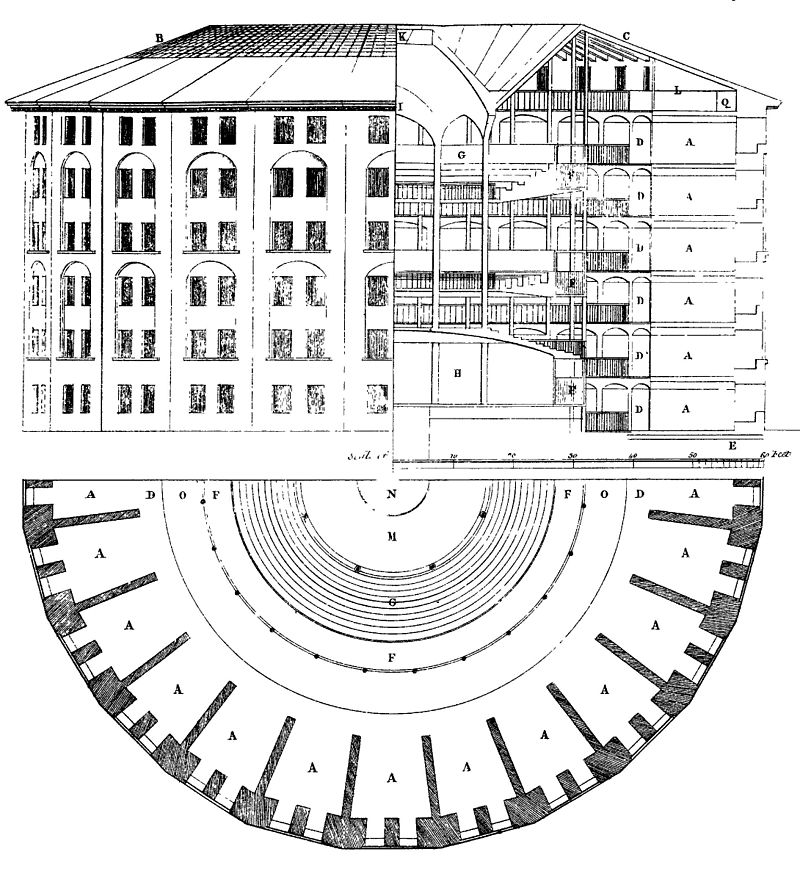
The lecture today on panopticism and institutional power was delivered by Richard. A lot of the lecture was focused on the theorist Michel Foucault, which I believe Richard has mentioned before. Foucault believed in knowledge, and knowledge as a form of power that could be applied. He thought that power has a relationship between people and because of this power could shape and control certain behaviour. This type of idea applied created the technique of 'Panopticism' which is seen in the physical form as a Panopticon. The Panopticon is a type of institutional building that designed by a social theorist and called Jeremy Bentham in the late 18th century. The idea behind the design of the Panopticon is to allow the inmates of an institution to be observed by a single watchman without the inmates being able to tell whether or not they are being watched. So the cells would be arranged in a circular fashion around a watchtower in the centre of them all known as an 'inspection house', which was blacked out so that you couldn't see into it from the position of the cell you were in. The inspection house housed a manager or staff of the institution. Although it is physically impossible for the single watchman that would have been on duty to observe all cells at once, the inmates in the cells cannot know if or when they are being watched means that if they want to avoid punishment the inmates must act as though they are watched at all times, effectively controlling their own behaviour throughout their stay in the prison. Bentham came up with the idea and thought that the basic plan of the circular outer ring, with the figurehead in the centre as being quite easily passed over to create institutions such as hospitals, schools, daycares, and asylums, but most of his efforts were assigned to developing it for a prison, and it is the prison which is most widely understood by the term. He also described the Panopticon as "a new mode of obtaining power of mind over mind, in a quantity hitherto without example', so he thought at the time that his design was the best at controlling the inmates and having the most amount of power over them, even through the fundamental process of having them kept in their cells. The process and design was so strong because for the use of a prison especially, it was an effective way of making sure the bad behaviour of the inmates was kept to a minimum, and there wasn't much interaction between the inmates themselves and the guards or management. The name, despite having roots in 'seeing' (opticon) is also a reference to 'Panoptes' from Greek mythology. He was a giant with lots of eyes, and seen to be a very effective watchman.
Foucault believed that the theory of panopticism was a metaphor for society, specifically how we are always being watched by those in power or by the people with authority, whether it be a teacher or a prison guard. He stated that
"the Panopticon is a model of how modern society organises its knowledge, its power, its surveillance of bodies, its training of bodies". A negative side product of Bentham's design is the oppression of people. When control is taken from the hands of the inmates and passed to another, in this case the prison which acts as a form of societal power, then manipulation and exploitation can occur. There is also an issue regarding the privacy of the inmates and their rights in this respect. This issue can also be seen in a modern society, and is often talked about. Often we are unaware of the amount of surveillance we are subject to. For example, CCTV affects us and our behaviour in a similar way to the effect of the Panopticon on the inmates. Though we are told and in many ways we are the beneficiaries of it being put into place, we may act to some extent differently whilst knowing we are being watched. Another example that was given in the lecture of this was in an educational setting. Seats are placed in a way that makes it so the teacher or the person in power can see all of the people attending, and in turn can observe everyone present, this was even evident in the lecture we were sitting in at the time. The arrangement makes it so the people sitting at the front, closer to the person in power could feel more pressured than the people further away to make sure they don't do anything wrong. This is just one example of the theory in practice, the teacher essentially has more control and power based on the way the seats for the students to sit in are organised.

No comments:
Post a Comment