I made a conscious decision at the beginning of the module to make sure I placed a lot of emphasis onto COP this year, as last year I felt I didn't do as well as I could of. My objective was to create a cohesive and complimentary pairing with both the essay and practical sides of the project. In doing this I made a conscious effort to improve my academic writing as much as I could, looking into good practice when phrasing an essay and presenting it in an academic way. I also tried to make sure small nuances such as the correct speech marks, (") or (') were used to make sure the essay was in the best way in terms of good practice in academic writing. I found the lecture and seminar program not only informative but also engaging. I discovered myself wanting to know more information about aspects of psychology such as Freudian theory and read the works of some of the philisophers that were discussed. In essence I think the combination of taking the extra step to learn about proper writing techniques and alternative learning methods will hopefully make other essays I write, and research I conduct a much more productive and beneficial process. The practical side of the module was another excercise in writing coupled with the sourcing of footage and presenting what I hoped would be an informative, entertaining and professional looking piece to accompany the essay I wrote. Through the practical I was able to demonstrate my research and understanding from a visual standpoint. I used a similar approach to the practical as last year, when I created somewhat of a video essay to expand on the topic that my essay compassed.
The context of practice module has been an unexpected learning curve this year, with attention being paid to academic studies and delving into areas that I didn't have much knowledge about. These include the media's influence, psychology of children and adolescents, major events in the past two decades and how to compose a strong argument in the form of an essay. I'm pleased with my choice in practical also, as I was able to put the research I did and what I had learnt to further use. I think the whole process of picking a research question to investigation and research and finally the writing of the essay has been an invaluable process and has undoubtedly given me good insight into how I learn. The question I chose had a variety of areas that it covered. Technology, society, psychology and culture were all angles that had to be considered at some stage during the process, which meant that I wasn't confined to one area and was able to argue a broad range of ideas because of this.
Overall this has been an incredibly insightful module. Looking at academic texts to writing them and a large amount of research has meant I've been able to learn a lot about various aspects of art and art history. But also aspects of psychology, sociology and philosophy. I've enjoyed the practical side of the module and creating a documentary. It meant I could write a script and combine narration with editing to create a piece that was both informative and entertaining. Finally, I think this module has given me a good basis for going into the context of practice 3 module with a better understanding of how to utilise resources, write a piece of academic text and create a complimentary practical piece to go with it.
Thursday, 28 April 2016

Wednesday, 27 April 2016
OUAN501 - Practical, Post Production
The final step in the process was post-production. There wasn't much to do in terms of tweaking or additional things that needed to be added, but there was a few elements I wanted to include to enhance the level of autheniticty and make the experience more complete for the viewer. The first thing I did was add a subtitle to a scene featuring an interview with 'Brad Bushmen', so that the audience knew exactly who was talking in conjunction with his name being revealed in the voiceover. As well as this ending credits allowed me to give credit to the numerous sources that I used and essentially thank the companies that I've taken footage from.
The very last adjustment I made simply to tie all of the elements together and essentially create a more cinematic feel to the piece was some colour correction. I put the exported documentary in premiere pro and used the three-way colour correction tool to make the dark colours more clue and put more yellow into the highlights. This kind of contrast creates a more cinematic feel and is only subtle but I think it adds quite a lot to the continuity of colours throughout the documentary. I was careful to make sure that the changes I made didn't take anything away from the game footage I was using as the colours are one of the aspects that I wanted to show case in the closing montage of the animation. It also meant that a little bit of the seemingly dark areas were taken out of the footage and made into a dark blue tone instead. With video work I like this kind of cinematic effect overall and I think it was a nice final adjustment to make with the documentary as a whole.


The very last adjustment I made simply to tie all of the elements together and essentially create a more cinematic feel to the piece was some colour correction. I put the exported documentary in premiere pro and used the three-way colour correction tool to make the dark colours more clue and put more yellow into the highlights. This kind of contrast creates a more cinematic feel and is only subtle but I think it adds quite a lot to the continuity of colours throughout the documentary. I was careful to make sure that the changes I made didn't take anything away from the game footage I was using as the colours are one of the aspects that I wanted to show case in the closing montage of the animation. It also meant that a little bit of the seemingly dark areas were taken out of the footage and made into a dark blue tone instead. With video work I like this kind of cinematic effect overall and I think it was a nice final adjustment to make with the documentary as a whole.
OUAN501 - Practical, Sequencing / Editing
This task took up the main bulk of the practical process and was the stage where all of the elements I'd worked on; sourcing footage, script writing, narration editing techniques and thoughts regarding music would come together and I'd see how everything worked as a piece on its own rather than seperate parts. It took a lot of hours to take the footage and isolate certain sections, ready for sequencing. It was during this stage that some improvisational occurs and decisions are made as to what sections of footage work best. At the beginning, 4 minutes sounded like a long time to me, but during the sequencing stage I soon realised how quickly it was and couldn't use as much of the footage as I initially thought.
What helped when I was editing everything together was the notes I had made on the script so that I knew what I had in mind when I wrote the original narration. This meant that I had the majority of the clips I needed essentially ready to place together. There were times however when I thought a particular video or news report would compliment what the narration was saying at the time quite well, so I went and gathered a few more video clips because of this. I enjoyed this process quite a lot because it felt like the closing stages of the project and all of the 'hard work' and planning was complete. I tried to add some humour and variety into the sequence, opening with a clip of a news reporter stating that he could tell Adam Lanza, the Sandy Hook perpatrator was a video game addict just by looking at him before cutting to the start of the main talking points. I tried to experiment a little with transitions and the spacing of video. I was conscious, however, that I would be overusing certain transitions and so used them sparingley where I thought they worked best for no more than five or six times throughout the entire documentary. Sometimes a simple cut works a lot better than a fade, and by doing this it means that the footage is on screen for a fraction longer without it fading to black. Aside from attempting to utilise a variety of different transition effects I wanted to make sure the spacing of video and the narration itself contained calculated pauses, so as to allow the audience to absorb the information. I figured that if it was a continuous three minutes of talking it would be harder for the audience to keep up with both the visuals and the narration. To make this easier and stagger different sections I made sure to incorporate scenes of interviews where I could to back up what I was saying and allow the audience to see other people talking first hand, this meant mine isn't the only voice that's heard for the full duration and breaks the audio up quite nicely. When it came to the volume of footage in comparison to the volume of my voice it was much louder. This was a simple fix and by increasing the volume of my voice clips by around 10, they were the same volume and there wasn't a discrepancy in volume between scenes. The timing of transitions was somewhat worked around the narration so that no visual was onscreen for too long. A tool that was invaluable during the process was the 'trimming' tool. This is one of the fastest ways to precisely cut up different sections of video footage and meant that I could hone in closely on even just a few sections of footage that needed to be isolated form a longer clip. Finally, I tried to experiment with timings. A couple of times in the piece the screen goes black for a short time after something is revealed. These types of timings I believe allow the audience to consider what they've learnt and adds to the effect of what is being communicated, for example if it was a dramatic piece of information, this helps to emphasise it.
I learnt a lot during this section of the process. I think this is the most thought I've put into the editing of a paricular piece, purely because success of it as a whole was so heavily reliant on it. I realised the importance of moderation with effects and transitions and I think the project has benefitted from this approach. The most difficult part was selecting footage that worked together, and also condensing so many hours of video into just a few minutes of short clips made the process quite complicated. In my opinion the documentary and narration was successful at communicated in a short time frame relevant information regarding perceptions and research on video games. I'm happy that I was able to incorporate the positives of video games, highlighting their artistic value and I think it was a good piece to compliment the work I did on my essay.


What helped when I was editing everything together was the notes I had made on the script so that I knew what I had in mind when I wrote the original narration. This meant that I had the majority of the clips I needed essentially ready to place together. There were times however when I thought a particular video or news report would compliment what the narration was saying at the time quite well, so I went and gathered a few more video clips because of this. I enjoyed this process quite a lot because it felt like the closing stages of the project and all of the 'hard work' and planning was complete. I tried to add some humour and variety into the sequence, opening with a clip of a news reporter stating that he could tell Adam Lanza, the Sandy Hook perpatrator was a video game addict just by looking at him before cutting to the start of the main talking points. I tried to experiment a little with transitions and the spacing of video. I was conscious, however, that I would be overusing certain transitions and so used them sparingley where I thought they worked best for no more than five or six times throughout the entire documentary. Sometimes a simple cut works a lot better than a fade, and by doing this it means that the footage is on screen for a fraction longer without it fading to black. Aside from attempting to utilise a variety of different transition effects I wanted to make sure the spacing of video and the narration itself contained calculated pauses, so as to allow the audience to absorb the information. I figured that if it was a continuous three minutes of talking it would be harder for the audience to keep up with both the visuals and the narration. To make this easier and stagger different sections I made sure to incorporate scenes of interviews where I could to back up what I was saying and allow the audience to see other people talking first hand, this meant mine isn't the only voice that's heard for the full duration and breaks the audio up quite nicely. When it came to the volume of footage in comparison to the volume of my voice it was much louder. This was a simple fix and by increasing the volume of my voice clips by around 10, they were the same volume and there wasn't a discrepancy in volume between scenes. The timing of transitions was somewhat worked around the narration so that no visual was onscreen for too long. A tool that was invaluable during the process was the 'trimming' tool. This is one of the fastest ways to precisely cut up different sections of video footage and meant that I could hone in closely on even just a few sections of footage that needed to be isolated form a longer clip. Finally, I tried to experiment with timings. A couple of times in the piece the screen goes black for a short time after something is revealed. These types of timings I believe allow the audience to consider what they've learnt and adds to the effect of what is being communicated, for example if it was a dramatic piece of information, this helps to emphasise it.
I learnt a lot during this section of the process. I think this is the most thought I've put into the editing of a paricular piece, purely because success of it as a whole was so heavily reliant on it. I realised the importance of moderation with effects and transitions and I think the project has benefitted from this approach. The most difficult part was selecting footage that worked together, and also condensing so many hours of video into just a few minutes of short clips made the process quite complicated. In my opinion the documentary and narration was successful at communicated in a short time frame relevant information regarding perceptions and research on video games. I'm happy that I was able to incorporate the positives of video games, highlighting their artistic value and I think it was a good piece to compliment the work I did on my essay.
OUAN501 - Practical, Sourcing Music
I didn't want to have music running throughout the entire piece, but towards the end an idea I had was to play a montage of video game footage revealing the artistic value it has and the incredibly visuals that have been made possibly within the medium. I wanted music that would compliment and emphasise this aspect of the documentary, preferrably an instrumental. I remembered a song that I thought would work well because it's recognisable and doesn't take your attention away from the visuals at all, in fact the way the song sounds in my opinion communicates to the audience that what they're seeing is something to be appreciated and a positive thing - which is exactly what I wanted. The song I chose was a cover of 'Pixies - Where is My Mind?' by Maxence Cyrin, a piano instrumental. I'm really happy that I was able to use it with this and although I only used around a minute of the song I think it was a nice ending to the documentary. Similar to the video footage this was sourced using the same software; 'Youtube Downloader' which allowed me to obtain the audio track off Youtube quite easily.
Considering that this is the only time music is played during the documentary I wanted a song that would have the biggest impact. This was a conscious choice as if music had been playing throughout the entirity of the documentary it would have had a much less of a significant effect on the audience and wouldn't have had the impact I intended. With this, I think the subtlety, combined with the familiarity of the song and the isolation of the track and the visuals at the end achieve what I wanted. Finally, just like with the video footage I used, the use of this song comes under fair use because of it's use in an educational video, for non profit and not to be shown in public, otherwise permission would have to of been obtained before it was used in the documentary.
Considering that this is the only time music is played during the documentary I wanted a song that would have the biggest impact. This was a conscious choice as if music had been playing throughout the entirity of the documentary it would have had a much less of a significant effect on the audience and wouldn't have had the impact I intended. With this, I think the subtlety, combined with the familiarity of the song and the isolation of the track and the visuals at the end achieve what I wanted. Finally, just like with the video footage I used, the use of this song comes under fair use because of it's use in an educational video, for non profit and not to be shown in public, otherwise permission would have to of been obtained before it was used in the documentary.
OUAN501 - Practical, Narration
As soon as I had finished the script I was fortunate enough to get a time to record the narration the very same day. This was the first time I had ever recorded my own voice so I anxious to see if I would be able to relay the script in a clear and colourful way. During the narration process I tried to avoid speaking in a monotone manner as much as I could and I think I progressively got better the more I did. The set up for the recording was as basic as it gets. It consisted of a condenser microphone behind a pop filter to block out any unwanted sounds and the software I used was audacity which simply allowed me to record a track and remove certain sections before exporting the audio file. Depspite the incredibly simple set up, it's all I needed for the purpose of recording the narration. From start to finish the recording process took just under an hour. I thought this was quite good since I had to sometimes do up to 10 takes on a single section. I contemplated the idea of recording smaller sections of the narration, around a sentence or two so that I could take regular breaks. I decided against this idea because it may result in a strange transition between sections half way through a section. I made sure to have around two or three version of each section unless it went smoothly first time. By doing this it meant I had a range of variations that I could swap out if something about a particular line or the way a word was said I didn't like. The experience itself was a big learning curve and I think doing it has improved my ability to narrate and recite a script. I believe this is because I could playback what I was saying and critique it in order to make adjustments. Initially I suspected that it would be strange hearing my own voice narrating something but this faded almost immediately, and it felt quite normal.
Overall I'm pleased with how the narration turned out and considering it's my first time narrating my own work I was relatively pleased with how it worked. I think I made the right decision to narrate it myself as oppose to getting someone else to do it because I knew exactly what I wanted and it allowed me to turn the recording round in about an hour. If time wasn't such a big factor at this stage I would have considering trying the narration with someone with a better voice for the task. However, I think by doing this it has given me the ability to realise first hand what goes into narrating something well and with a little more practice I think I could improve quite a lot. One regret I have is not taking a bottle of water with me to drink inbetween takes. I hadn't realised how dry my voice would become and how quickly this would happen - this is simply due to a lack of experience. Due to this in parts my voice does sound a little more raspy than usual but it isn't really destrimental to the piece.

Overall I'm pleased with how the narration turned out and considering it's my first time narrating my own work I was relatively pleased with how it worked. I think I made the right decision to narrate it myself as oppose to getting someone else to do it because I knew exactly what I wanted and it allowed me to turn the recording round in about an hour. If time wasn't such a big factor at this stage I would have considering trying the narration with someone with a better voice for the task. However, I think by doing this it has given me the ability to realise first hand what goes into narrating something well and with a little more practice I think I could improve quite a lot. One regret I have is not taking a bottle of water with me to drink inbetween takes. I hadn't realised how dry my voice would become and how quickly this would happen - this is simply due to a lack of experience. Due to this in parts my voice does sound a little more raspy than usual but it isn't really destrimental to the piece.
OUAN501 - Practical, Sourcing Footage
One of the longer processes throughout the projection was the sourcing of footage. Despite doing the bulk of it at the beginning I found myself continuously searching for additional footage to compliment smaller sections of the script and overall add extra visuals for the bettering of communication to the audience. The vast majority of the videos I needed and ended up using were available on Youtube, and to obtain them I used the free tool, 'Youtube Downloader', which simply downloads the videos from the site in a desired resolution. Luckily a lot of the footage I wanted was available at either 720p or 1080p. Although, footage of news broadcasts from the 90's and early 2000's was only available in a very low resolution and had to be scaled up. This footage also wasn't availabe in widescreen so the aspect ratio of footage changes slightly throughout the video, this isn't too much of a problem though, and in some ways I thik it adds to the distinction between certain time periods and between individual clips. As previously mentioned, the gathering of footage was made immensly easier because I'm a student making a film for the purposes of education and not for profit. Otherwise permission would have to have been given by the authors of the original material. In total I believe I gathered around 40 to 50 seperate clips of footage all ranging from between a minute for something like a game trailer to 30 minutes for a news broadcast or even longer in the case of the clips from the 1993 video game conference. In total this amounts to between 4 and 5 hours of footage. I did spend a large amount of time looking through certain footage for specific sections that worked best, but in most cases I already knew what I was looking for within certain footage and it was simply a case of finding it and adding it to the sequence. I had a lot of choice and was quite constantly throughout the process making decision on how certain footage would look when sequenced with elements. I had a concern at the beginning that the change of quality in footage between something from the 90's to someting in full HD from recently would be too much of a contrast and would look poorly sequenced but it actually worked quite well in practice and didn't pose and issues for me. The different types of footage I wanted to aquire was a mixture of news broadcasts, video game footage and trailers, interviews with the people I was discussing in the narration and images of essays or studies that I was discussing. This gave me everything I needed to visually represent what I was talking about and I probably have created something that was around 30-45 minutes in length if I'd wanted to, given the amount of video that I had to work with.


OUAN501 - Practical, Script Writing
I've always been quite font of writing, and enjoy the process of scriptwriting. I spent quite a few hours on this particular script because I was constantly removing and adding certain sections. This is the second time I've written a script for a documentary format and within a similar time frame too so I was quite used to the process. I wanted to make the editing and sequencing stage of the process as straight forward as possible, so I made sure to note down and directions for fades or the way certain elements should move within the script. I also added notes for certain sections that I had in mind to be in the background of the narration. For example, a montage playing at the end of the documentary. This was for the purpose of ease and overall organisation so that a later stage I wasn't scrambling to remember what my intention was with a particular section or phrase. Incorporating 'visual directions' to an extent made the overall process easier and also made the narration read much more like an actual script on paper.
A lot of the information I included in the documentary stemmed from my essay with some additional information that I either couldn't include due to the length of the essay or wasn't as relevant to my question. Writing the script with this in mind gave me the opportunity to expand on my research and what I had written, and use all of the information I'd collected. Coupled with this, when I was writing the script I realised that some of my original sources had been from documentaries or television programs. Tying in the narration some of the relevant sections of a television program for example also meant that I could in turn include excerpts from that program within the documentary. I was aiming for the script to work with a documentary that's around 3 to 5 minutes in length. I knew from last time I wrote a script for a piece with a 2 minute cap that it should be around 500 words or so, which would equate to around 3 minutes of talking depending on how fast I spoke. Of course, one redeeming factor is that I could cut section out after the narration was complete if I thought I had too much, I didn't want it to be too long however. Another aspect to the script I wanted to achieve was a natural flow from each section and area of subject matter to the next. I imagined that by linking various sections to another based on how relevant the material was would be an obvious approach, but also use language and words to my advantage to create seamless transitions between ideas that would only really be apparent in the visuals. Finally, there was something pleasing about the script I created in that when I was writing my essay I was trying to use appropriate language that suited, and also use a range of vocabulary to make the essay read as well as it could. With the documentary it feels and is much more conversational so it was easier to work and think of how to say something because it had to be communicated quickly and longer words were niether appropriate nor necessary.
I'm quite happy with how the script turned out and I think I've managed to contain all of the subject matter I wanted within it. In hindsight the ending does feel like it could have been a bit stronger and it tapers of quite abruptly - so this is something I would improve upon overall. Depsite this I think the length of the script and subsequent narration is an appropriate length for the context and purpose of the documentary piece I was creating.


A lot of the information I included in the documentary stemmed from my essay with some additional information that I either couldn't include due to the length of the essay or wasn't as relevant to my question. Writing the script with this in mind gave me the opportunity to expand on my research and what I had written, and use all of the information I'd collected. Coupled with this, when I was writing the script I realised that some of my original sources had been from documentaries or television programs. Tying in the narration some of the relevant sections of a television program for example also meant that I could in turn include excerpts from that program within the documentary. I was aiming for the script to work with a documentary that's around 3 to 5 minutes in length. I knew from last time I wrote a script for a piece with a 2 minute cap that it should be around 500 words or so, which would equate to around 3 minutes of talking depending on how fast I spoke. Of course, one redeeming factor is that I could cut section out after the narration was complete if I thought I had too much, I didn't want it to be too long however. Another aspect to the script I wanted to achieve was a natural flow from each section and area of subject matter to the next. I imagined that by linking various sections to another based on how relevant the material was would be an obvious approach, but also use language and words to my advantage to create seamless transitions between ideas that would only really be apparent in the visuals. Finally, there was something pleasing about the script I created in that when I was writing my essay I was trying to use appropriate language that suited, and also use a range of vocabulary to make the essay read as well as it could. With the documentary it feels and is much more conversational so it was easier to work and think of how to say something because it had to be communicated quickly and longer words were niether appropriate nor necessary.
I'm quite happy with how the script turned out and I think I've managed to contain all of the subject matter I wanted within it. In hindsight the ending does feel like it could have been a bit stronger and it tapers of quite abruptly - so this is something I would improve upon overall. Depsite this I think the length of the script and subsequent narration is an appropriate length for the context and purpose of the documentary piece I was creating.
OUAN501 - Practical, Planning
As a practical piece a lot of the work before I could start creating the actual piece was in the planning. During this stage I had to make key decisions for the final piece, such as a timeframe to contain the documentary within, topics to discuss and other parts of footage that I wanted to include from various news broadcasts over the past few decades and the different game footage to include. It's during this early stage that I wrote the script ready for recording and arguably recorded the narration before the production process began. This task quite quite daunting at first because I had all of these different elements that I wanted to include and needed to work on indivudually before bringing them together, so it was difficult to pin point a way to start or what to prioritise. Ultimately it came down to multitasking and undertaking a variety of tasks at once. I found myself planning certain elements as they came into my head and undertaking certain aspects simutaniously because they had to match up in some respects. For example, when I was writing the script, after I had written a section I looked for videos and sourced footage that could work well with that particular section of the script. This was also because, after the script was complete I didn't want to have to go back through each section and source videos. This in my opinion was a more efficient and effective way of collecting material as it was also relevant to my thoughts at the time and I may have misinterpreted what I wanted to convey visually if I had done it at a later date.
One of the most difficult things about the preparation of my practical piece was that I needed to take everything I had learnt and researched over the past few months and condense it down to around 3 minutes of narration time and 3 to 4 minutes of footage. During the process I was concerned that the documentary wouldn't be entertaining as well as informative, from this perspective I wanted to make sure that the audience remained engaged. The visuals would help this but I was hoping to be able to sequence everything together in such a way that it was interesting but the information was relayed in a specific way to the audience. When I'm watching a documentary or a piece an informative video the visuals are fast paced and a lot of examples are given. This makes the concept that's being communicated or taught, much easier to understand and engage with - this is what I will be attempting to do in my practical.
One of the most difficult things about the preparation of my practical piece was that I needed to take everything I had learnt and researched over the past few months and condense it down to around 3 minutes of narration time and 3 to 4 minutes of footage. During the process I was concerned that the documentary wouldn't be entertaining as well as informative, from this perspective I wanted to make sure that the audience remained engaged. The visuals would help this but I was hoping to be able to sequence everything together in such a way that it was interesting but the information was relayed in a specific way to the audience. When I'm watching a documentary or a piece an informative video the visuals are fast paced and a lot of examples are given. This makes the concept that's being communicated or taught, much easier to understand and engage with - this is what I will be attempting to do in my practical.
OUAN501 - Practical, Introduction
For my context of practice practical, I wanted to make a documentar or video essay style piece that would reinforce and compliment my essay. Aside from the scientific and more structured approach I entertained in my essay there is a whole other side to the perception of video games that I wanted to cover. Aside from this I wanted to create an accompanying visual piece that would demonstrate some of the elements I was discussing through the use of news footage and other found videos. Ultimately the video essay would be a less serious and less academic look at one aspect of video game culture in terms of the controversy and research that has been done on the topic. Using this format also meant I could include actual game footage as oppose to leaving the audience in the dark when discussing certain games for example. News footage and broadcasts plays a large part in propagating stigmas, so sequencing different broadcasts together can effectively demonstrate the level to which this kind of idea is spoken about, and can be witnessed first hand the tone of voice and manner in which the information is relayed. My first thoughts on the method that I'll be using to approach this project is that it will start with a lot of preparation and sourcing of footage. I have a couple of ways that I can source footage, for example through Youtube and other streaming sites. It's important to note that because this is a student film and being made purely for the purposes of education without a monetery a financial gain - the use of this footage is acceptable. However, if I was making this documentary for a client or to be shown publically it would mean that I would have to contact the authors of the footage for permissions, and in some cases may have to pay for the content. Other early considerations I'll be making including the tone of the script and the information I'm relaying as well as music and sound design. I want each element of the piece to work well to create an overall tone throughout. This means making sure that the audio, visuals and pacing, combined with the editing needs to be cohesive.
I also saw this as an opportunity to brush up on my editing skills and create a small documentary using found footage and my own narration. Recently I've been watching a lot of documentary style work and the editing has been more and more obvious to me. Tied with this, I think I could use what I've learnt through watching other work and put it to use during the production of my practical piece. Work that comes to mind includes the documentaries produced by Michael Moore, specifically 'Bowling for Columbine' which in turn gave me a lot of information for my essay and some of the themes of gun control and fun violence. I suppose in a way the approach Michael Moore took with that documentary and how it made me feel ultimately inspired my practical piece. Coupled with this, looking at material published on sites such has Youtube has given me a huge range of references and insight into the way videos and editing can be constructed to form video essays that aren't too wordy, and contain a good balance of visuals and spoken information - one of the most helpful being, 'Every Frame a Painting', a video essay series produced by editor Tony Zhou.


I also saw this as an opportunity to brush up on my editing skills and create a small documentary using found footage and my own narration. Recently I've been watching a lot of documentary style work and the editing has been more and more obvious to me. Tied with this, I think I could use what I've learnt through watching other work and put it to use during the production of my practical piece. Work that comes to mind includes the documentaries produced by Michael Moore, specifically 'Bowling for Columbine' which in turn gave me a lot of information for my essay and some of the themes of gun control and fun violence. I suppose in a way the approach Michael Moore took with that documentary and how it made me feel ultimately inspired my practical piece. Coupled with this, looking at material published on sites such has Youtube has given me a huge range of references and insight into the way videos and editing can be constructed to form video essays that aren't too wordy, and contain a good balance of visuals and spoken information - one of the most helpful being, 'Every Frame a Painting', a video essay series produced by editor Tony Zhou.
Monday, 25 April 2016
OUAN501 - Planning & Structuring an Essay


My first choice for an essay question was, 'Violent Video Games, Cause or Scapegoat?' This at the time was a placeholder essentially until I decided on a specific question that I was tackling in my essay. Eventually the question was more specific, and I tried to make it sound academic whilst also containing the aims and intentions of the essay. The proposed title question was, 'To what extent is video game violence associated with aggression, and to what degree is this idea propagated in the media?'
I have between 40-50 academic sources on the topic from various studies and papers sourced online, as well as from books written on the topics of video games, aggression and more general books written on the relatioship between media violence and aggression. I found usually and for the most part depending on when they were published these kinds of books looking at aggression from a psychological stand point had atleast a section on the effects of video game violence on the individuals that play them. Below are several more examples of studies on the topic;
- Ferguson, C.J. (2010) ‘Blazing angels or resident evil? Can violent video games be a force for good?’, . doi: 10.1037/a0018941.
- Ferguson, C.J. (2013) ‘Violent video games and the supreme court lessons for the scientific community in the wake of brown v. Entertainment merchants association’, . doi: 10.1037/a0030597.
- Freedman, J.L. (2002) Media violence and its effect on aggression: Assessing the scientific evidence. Toronto: University of Toronto Press.
- Gross, J. and Levenson, R.W. (2009) ‘Emotional suppression: Physiology, self-report, and expressive behavior’, Journal of Personality and Social Psychology, 64(6), pp. 970–986.
- Grossman, D., DeGaetano, G. and Grossman, L.C.D. (1999) Stop teaching our kids to kill: A call to action against TV, movie & video game violence. New York: Crown Publishing Group (NY).
- Ivory, J.D. and Kalyanaraman, S. (2007) ‘The effects of technological advancement and violent content in video games on players? Feelings of presence, involvement, physiological arousal, and aggression’, Journal of Communication, 57(3), pp. 532–555. doi: 10.1111/j.1460-2466.2007.00356.x.
- Lee, D. (2014) Aggression from video games ‘linked to incompetence’. Available at: http://www.bbc.co.uk/news/technology-26921743 (Accessed: 16 April 2016).
In terms of material to analyse I plan to look at a wide range of video games, and look at the medium as a whole. I will however focus on games that are often discussed in studies and the conversation on video game violence. These include titles such as 'Doom', which was a big talking point after the Columbine High School massacre, Mortal Kombat and Grand Theft Auto which are regularly brought up in the ongoing discussion about video games because of their content. Concerns about this and their association with violent behaviour are often at the forefront of the effects of video games.
My thesis for this essay is based around the idea that when an individual commits an act of extreme violence, video games are often blamed when there may be much more prevelant and pressing factors that caused the event. I do not believe video games have a significant effect on aggression and furthermore I plan to discuss the effect the media has on its audience when it states that a mass murderer played video games. I plan to discuss a range of point;
- The history of the media's involvement with violence in video games and how the it has caused panic among parents, researchers and politicians.
- What current and past studies have concluded from their research.
- How the media propagates the link between aggression an violent video games.
- Ecological validity of the research and claims that have been made.
- Research and focus on desensitisation to violence through exposure to violent video games.
- Compare different studies and experiments that have been conducted, combined with the different conclusions and opinions of the researchers that did them.
I again gathered some peer feedback from Emma on my ideas;
'Nicely structured essay plan. You might benefit from doing a close reading of a specific study of a video game related incident and report upon how the media neglected certain aspects of the incident to propagate panic and encourage the negative opinions of violent video games.'
OUAN501 - Establishing a Research Question


For the research question I want to look at video games. I think this satisfies the criteria for the essay question by being a form of interactive media, and also has elements of animation, sound and huge amounts of design contained with them. Aside from this they are an incredibly popular form of entertainment and are a large part of every day life for a lot of people. Continually and specifically in the US video games are a source of controversy, whether through their depictions of violence and adult themes or due to their alledged effect on children and aggression as a whole. Coupled with this, I'm interested in the way the media propagates views to audiences about video games and how this can have a negative effect on video games as a whole.
After looking at the module sources, I realised there isn't a lot of crossover between my chosen topic and the resources that are available. Howeve, 'Cultural Theory & Popular Culture' by J. Storey has a cultural and social implication that could be useful to me when looking at society as a whole, the way society functions and operates in regards to popular views and the way moral panic can occur among members of that society. Furthermore, 'Capital, Volume I' a book by Karl Marx may be relevant as it discusses capitalism as political economy, also looking at economic laws of the capitalist mode of production. The specifics in the book may not necessarily be relevant but I think the popularity of video games and the addiction to them that can occur could potentially tie in with consumerism and writings like ths quite well. Finally, 'Disipline & Punish' by Michel Foucault looks at an analysis of the social and theoretical mechanisms behind the changes that occurred in Western penal systems during the modern age. I think methods of punishment as well as displine as a whole and the psychological implications of this research could compliment my research rather well. Also, when I'm looking at aggression or violence the methods of punishment and displine with offenders could be quite interesting to think about in connection with one another.
I already know quite a lot of different sources on the topic of violence and aggression with a link to video games. When looking for research papers and studies on the topic the same names come up and have a lot of experience on the subject, these include; 'Craig A. Anderson, Brad Bushman, Christopher Furgerson and Dr Andrew Przybylski. There are however quite a lot of other studies by researchers that encompass this topic, and aside from this I think there is a lot of opportunity to involve papers on psychology and child psychology.
- American Psychological Society Copyright (2001) Meta-Analytic review of video-game violence 354. Available at: http://public.psych.iastate.edu/caa/abstracts/2000-2004/01AB.pdf (Accessed: 16 April 2016).
- Anderson, C.A., Shibuya, A., Ihori, N., Swing, E.L., Bushman, B.J., Sakamoto, A., Rothstein, H.R. and Saleem, M. (2010)
- Violent video game effects on aggression, empathy, and Prosocial behavior in eastern and western countries: A Meta-Analytic review. Available at: https://www.apa.org/pubs/journals/releases/bul-136-2-151.pdf (Accessed: 18 April 2016).
- Are Video Games Really That Bad? (2015) BBC, 17 October.
- Ascione, F.R. and Arkow, P. (1999) Child abuse, domestic violence, and animal abuse linking the circles of compassion for prevention and intervention. West Lafayette, IN: Purdue University Press. Australia, C. of (2010) Literature review on the impact of playing violent video games on aggression. Available at: http://www.classification.gov.au/Public/Resources/Pages/Other%20Resources/Literature%20review%20on%20the%20impact%20of%20playing%20violent%20video%20games%20on%20aggression.pdf (Accessed: 16 April 2016).
- Ballard Mary 1996 mortal Kombat (1996) Available at: https://libres.uncg.edu/ir/asu/f/Ballard_Mary_1996_Mortal_Kombat.pdf (Accessed: 16 April 2016).
In terms of investigating this research question and making a response I would like to make a documentary or video essay style piece. My thinking behind this is that since the topic has a lot of news coverage, I can use found footage of news broadcasts to compile and informative and entertaining piece. By doing this I can also combine my own research and commentary with in game footage and expand on the topic I've already covered. Furthermore, it means I can practice editing clips and make my editing more effective to create something both informative and entertaining.
I showed Emma my research question in order to get some peer feedback, she said;
'I think this is a really interesting idea. It'd be nice if you looked into hard facts and statistics and possibly prove them wrong to demonstrate how the media exaggerate and emphasise on the negative effects, and how they don't tell the whole story behind such games related to incidents. E.g how the person unlucky sufferers from mental illness etc.'
OUAN501 - Outside Collett Dickenson Pearce (11)
One of our final lectures was delivered by Janine Sykes on a case-study of (advertising practice) research she did titled, 'Outside Collett Dickenson Pearce'. Collett Dickenson Pierce being a British advertising agency which operated from 1960 till 2000. The agence was founded by John Pearce and Ronnie Dickenson who bought an existing agency owned by John Collett. Thus creating the name Collet-Dickinson-Pierce.
I believe the purpose of the lecture was to demonstrate to us as a year about the importance of research. Furthermore, she had to show us a full example of a case study from start to finish. This was a good example to us about how to go about creating a large body of research with a final end goal, especially when approaching the COP2 and even more so, the COP3 module next year. Through the example we would be shown process that we would be able to understand from a research perspective; understand the nature of a case study and (practice-based) research; gather insight into contextual analysis, see into the research findings that were collected and finally, like I previously mentioned, give us some important tools that would help with our COP 2 and 3 modules.
It was interesting to see how the research developed and what steps were taken in order to advance and broaden the information that was being collected. During the initial research that was done by speaking to people, reading from sourced and interviewing people for first hand accounts the name 'Collin Millward' came up. From here, it opened up a whole new avenue of research for the study. This was quite eye opening for me, and it showed me the relevance of talking to people and finding out as much as possible. It also demonstrated to me the way that research can progress through different ways, in this case it led to former LCA student, 'Collin Millward'. Research questions were also devised to further the development of the study. Layout out questions such as this gives a more objective driven study and gives the research a purpose and direction rather than finding out as much as possible only to have to scan through it for the more relevant information later.
Once the questions had been established, Janine went to the 'History of Advertising Trust' to collect more information about Collett Dickenson Piece. Archivists helped her to discover what she was looking for, and using sources such as D&AD catalogues she was able to collect even more information. Janine eventually curated an exhibition around Collett Dickenson Pierce titled, 'Outside Collett Dickenson Pierce.'

I believe the purpose of the lecture was to demonstrate to us as a year about the importance of research. Furthermore, she had to show us a full example of a case study from start to finish. This was a good example to us about how to go about creating a large body of research with a final end goal, especially when approaching the COP2 and even more so, the COP3 module next year. Through the example we would be shown process that we would be able to understand from a research perspective; understand the nature of a case study and (practice-based) research; gather insight into contextual analysis, see into the research findings that were collected and finally, like I previously mentioned, give us some important tools that would help with our COP 2 and 3 modules.
It was interesting to see how the research developed and what steps were taken in order to advance and broaden the information that was being collected. During the initial research that was done by speaking to people, reading from sourced and interviewing people for first hand accounts the name 'Collin Millward' came up. From here, it opened up a whole new avenue of research for the study. This was quite eye opening for me, and it showed me the relevance of talking to people and finding out as much as possible. It also demonstrated to me the way that research can progress through different ways, in this case it led to former LCA student, 'Collin Millward'. Research questions were also devised to further the development of the study. Layout out questions such as this gives a more objective driven study and gives the research a purpose and direction rather than finding out as much as possible only to have to scan through it for the more relevant information later.
- What type of art education did Collins & Millward experience at LCA? And could this have contributed to their successes?
- What were the contextual influences upon CDP work (1970s)?
- What’s so distinctive about their creative work?
- Where are Millward’s paintings David Puttnam mentioned?
- Why is CDP (still) most successful ad agency (creative awards) in the world?
Once the questions had been established, Janine went to the 'History of Advertising Trust' to collect more information about Collett Dickenson Piece. Archivists helped her to discover what she was looking for, and using sources such as D&AD catalogues she was able to collect even more information. Janine eventually curated an exhibition around Collett Dickenson Pierce titled, 'Outside Collett Dickenson Pierce.'
OUAN501 - The Gaze (10)
This lecture was delivered to us by Dr Brenda Hollweg on the topic of the gaze in film and art. 'Gaze' means "to look steadily, intently, and with fixed attention."
The male gaze is a concept derived by the feminist film critic, Laura Mulvey. The 'the male gaze' relates to the way visual arts are structured around a male viewer. Laura Mulvey first introduced the second-wave feminist concept of "male gaze" in her essay 'Visual Pleasure and Narrative Cinema', where she states, 'The determining male gaze projects its phantasy on to the female figure which is styled accordingley'. (Mulvey L., 1975) The concept was actually present previous to this in earlier studies looking at the concept of the gaze, but it was Mulvey who popularised the idea. Mulvey's thoughts were that women were objectified in film because heterosexual men were behind the camera and in control of it. Subsequently, theories regarding the 'male gaze' have been influential in feminist film theory and media studies. Interestingly, the word 'gaze' has a variety of meanings. The dictionary defines the term as, 'to look steadily and intently, especially in admiration, surprise or thought'. But like previously mentioned, the word is also used amongst film theorists and feminists to describe the way an audience looks upon the characters in film.
There are four key forms of the gaze;
Intra-diegetic gaze refers to the action of a main male character looking at the female character as part of film story (this ‘gaze’ is often created by a subjective ‘point-of-view shot’). Next, 'direct' means an address to the viewer: e.g., the gaze of a person in the film looking ‘out of the frame’ as if at the viewer. 'Look of the camera' is the way that the camera appears to look at the characters depicted less metaphorically, essentially the gaze of the film-maker, or what the film maker was viewing through the lens. Finally, 'spectators gaze' is quite self explanitory as it describes the gaze of the viewer at an image of a person (or animal, or object) in the film.
I suppose in a sense the idea of the 'male gaze' is much more appropriate when applied to film theory, but may be able to be applied to animation as well. Laura Mulvey described the way in which women in film are objectified because heterosexual men are in control of the camera. In this sense alone, it could be applied to animation because the concept of a camera and the point of view for the audience is as important in animation as film. The principles of cinematography and the way a camera is used to tell the story is also a large part of animation, and by doing this the audience's attention can be directed in the same way. In conjunction with the idea of the 'male gaze' we were informed about the term scopophilla. This term was introduced to translate Freud's Schaulust, or pleasure in looking. Freud himself considered pleasure in looking to be a regular instinct in childhood. In other words during childhood there exists a natural desire to look and curiosity of other peoples bodies. Laura Mulvey also spoke about the ida of scopophilla, ‘at the extreme [scopophilia] can become fixated into a perversion, producing obsessive voyeurs and Peeping Toms whose only sexual satisfaction can come from watching, in an active controlling sense, an objectified other.’
Psychodynamics is an approach to psychology that looks at psychological forces underlying different aspects of human behavior for example, feelings and emotions and how they might relate to early experience. Throughout the last century, art historians, philosophers, literary theorists and professors of social histories and cultural studies have all engaged with psychodynamic theories. On the topic of art and psychology, John Berger said in his book 'Ways of Seeing, ‘almost all post-Renaissance European sexual imagery is frontal – either literally or metaphorically – because the sexual protagonist is the spectator-owner looking at it.' Again reinforcing the way the gaze can be seen in art throughout history.
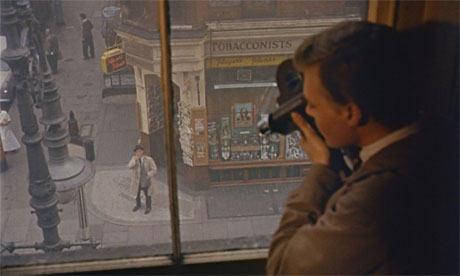 Still from 'Peeping Tom', 1960
The male gaze is a concept derived by the feminist film critic, Laura Mulvey. The 'the male gaze' relates to the way visual arts are structured around a male viewer. Laura Mulvey first introduced the second-wave feminist concept of "male gaze" in her essay 'Visual Pleasure and Narrative Cinema', where she states, 'The determining male gaze projects its phantasy on to the female figure which is styled accordingley'. (Mulvey L., 1975) The concept was actually present previous to this in earlier studies looking at the concept of the gaze, but it was Mulvey who popularised the idea. Mulvey's thoughts were that women were objectified in film because heterosexual men were behind the camera and in control of it. Subsequently, theories regarding the 'male gaze' have been influential in feminist film theory and media studies. Interestingly, the word 'gaze' has a variety of meanings. The dictionary defines the term as, 'to look steadily and intently, especially in admiration, surprise or thought'. But like previously mentioned, the word is also used amongst film theorists and feminists to describe the way an audience looks upon the characters in film.
There are four key forms of the gaze;
- Intra-diegetic gaze
- Direct
- Look of the camera
- Spectators gaze
Intra-diegetic gaze refers to the action of a main male character looking at the female character as part of film story (this ‘gaze’ is often created by a subjective ‘point-of-view shot’). Next, 'direct' means an address to the viewer: e.g., the gaze of a person in the film looking ‘out of the frame’ as if at the viewer. 'Look of the camera' is the way that the camera appears to look at the characters depicted less metaphorically, essentially the gaze of the film-maker, or what the film maker was viewing through the lens. Finally, 'spectators gaze' is quite self explanitory as it describes the gaze of the viewer at an image of a person (or animal, or object) in the film.
I suppose in a sense the idea of the 'male gaze' is much more appropriate when applied to film theory, but may be able to be applied to animation as well. Laura Mulvey described the way in which women in film are objectified because heterosexual men are in control of the camera. In this sense alone, it could be applied to animation because the concept of a camera and the point of view for the audience is as important in animation as film. The principles of cinematography and the way a camera is used to tell the story is also a large part of animation, and by doing this the audience's attention can be directed in the same way. In conjunction with the idea of the 'male gaze' we were informed about the term scopophilla. This term was introduced to translate Freud's Schaulust, or pleasure in looking. Freud himself considered pleasure in looking to be a regular instinct in childhood. In other words during childhood there exists a natural desire to look and curiosity of other peoples bodies. Laura Mulvey also spoke about the ida of scopophilla, ‘at the extreme [scopophilia] can become fixated into a perversion, producing obsessive voyeurs and Peeping Toms whose only sexual satisfaction can come from watching, in an active controlling sense, an objectified other.’
Psychodynamics is an approach to psychology that looks at psychological forces underlying different aspects of human behavior for example, feelings and emotions and how they might relate to early experience. Throughout the last century, art historians, philosophers, literary theorists and professors of social histories and cultural studies have all engaged with psychodynamic theories. On the topic of art and psychology, John Berger said in his book 'Ways of Seeing, ‘almost all post-Renaissance European sexual imagery is frontal – either literally or metaphorically – because the sexual protagonist is the spectator-owner looking at it.' Again reinforcing the way the gaze can be seen in art throughout history.
Still from 'Peeping Tom', 1960
Subscribe to:
Comments (Atom)