The male gaze is a concept derived by the feminist film critic, Laura Mulvey. The 'the male gaze' relates to the way visual arts are structured around a male viewer. Laura Mulvey first introduced the second-wave feminist concept of "male gaze" in her essay 'Visual Pleasure and Narrative Cinema', where she states, 'The determining male gaze projects its phantasy on to the female figure which is styled accordingley'. (Mulvey L., 1975) The concept was actually present previous to this in earlier studies looking at the concept of the gaze, but it was Mulvey who popularised the idea. Mulvey's thoughts were that women were objectified in film because heterosexual men were behind the camera and in control of it. Subsequently, theories regarding the 'male gaze' have been influential in feminist film theory and media studies. Interestingly, the word 'gaze' has a variety of meanings. The dictionary defines the term as, 'to look steadily and intently, especially in admiration, surprise or thought'. But like previously mentioned, the word is also used amongst film theorists and feminists to describe the way an audience looks upon the characters in film.
There are four key forms of the gaze;
- Intra-diegetic gaze
- Direct
- Look of the camera
- Spectators gaze
Intra-diegetic gaze refers to the action of a main male character looking at the female character as part of film story (this ‘gaze’ is often created by a subjective ‘point-of-view shot’). Next, 'direct' means an address to the viewer: e.g., the gaze of a person in the film looking ‘out of the frame’ as if at the viewer. 'Look of the camera' is the way that the camera appears to look at the characters depicted less metaphorically, essentially the gaze of the film-maker, or what the film maker was viewing through the lens. Finally, 'spectators gaze' is quite self explanitory as it describes the gaze of the viewer at an image of a person (or animal, or object) in the film.
I suppose in a sense the idea of the 'male gaze' is much more appropriate when applied to film theory, but may be able to be applied to animation as well. Laura Mulvey described the way in which women in film are objectified because heterosexual men are in control of the camera. In this sense alone, it could be applied to animation because the concept of a camera and the point of view for the audience is as important in animation as film. The principles of cinematography and the way a camera is used to tell the story is also a large part of animation, and by doing this the audience's attention can be directed in the same way. In conjunction with the idea of the 'male gaze' we were informed about the term scopophilla. This term was introduced to translate Freud's Schaulust, or pleasure in looking. Freud himself considered pleasure in looking to be a regular instinct in childhood. In other words during childhood there exists a natural desire to look and curiosity of other peoples bodies. Laura Mulvey also spoke about the ida of scopophilla, ‘at the extreme [scopophilia] can become fixated into a perversion, producing obsessive voyeurs and Peeping Toms whose only sexual satisfaction can come from watching, in an active controlling sense, an objectified other.’
Psychodynamics is an approach to psychology that looks at psychological forces underlying different aspects of human behavior for example, feelings and emotions and how they might relate to early experience. Throughout the last century, art historians, philosophers, literary theorists and professors of social histories and cultural studies have all engaged with psychodynamic theories. On the topic of art and psychology, John Berger said in his book 'Ways of Seeing, ‘almost all post-Renaissance European sexual imagery is frontal – either literally or metaphorically – because the sexual protagonist is the spectator-owner looking at it.' Again reinforcing the way the gaze can be seen in art throughout history.
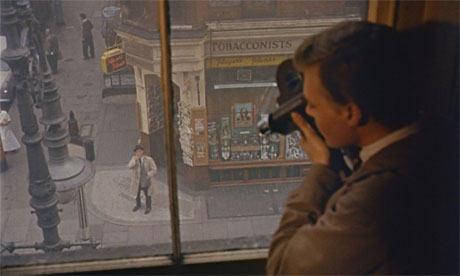 Still from 'Peeping Tom', 1960

No comments:
Post a Comment