Monday, 21 December 2015

OUAN501 - Desire (7)

This lecture on the theory of desire was delivered by Simon Jones, with an emphasis on the theories of Sigmund Freud and Jacques Lacan.

Sigmund Freud was an Austrian neurologist and seen as the founder of psychoanalysis. Psychoanalysis is a clinical method for treating psychopathology through the conversation between a patient and a psychoanalyst. He established psycho-analysis in 1880s as a form of psycho-therapy, “the talking cure” treated “hysteria” patients – symptoms manifested from psychic traumas. The theory of desire lies in ideas of repression and the unconscious. Furthermore, infantile sexuality stages of psychosexual development. Tying in with this were were referred to the Oedipus complex, which is was one of the more unusual things I've been informed, so it was quite difficult to interpret it at first, but very interesting. Essentially, the Oedipus complex is the concept used to explain the emotions and ideas that the mind keeps in the unconscious, via something called dynamic repression, that concentrates upon a child's desire to have sexual relations with the parent of the opposite sex (i.e. males attracted to their mothers, and females attracted to their fathers). In addition to this, The "Oedipal complex" refers to the sexual relations and desire shared between a son and his mother and does not have to be reciprocated.

In Freudian theory, a child's identification with the same-sex parent is the successful resolution of the Oedipus complex. Successful resolution of the Oedipus complex is a psychological experience 'necessary for the development of a mature sexual role and identity'. Following this, Sigmund Freud suggested that boys and girls experience the complexes differently. Boys in a form of anxiety around the idea of castration, and girls in a form of penis envy. 'The unsuccessful resolution of the complexes might lead to neurosis, pedophilia, and homosexuality'. It was stated that, 'men and women who are fixated in the Oedipal and Electra stages of their psychosexual development might be considered "mother-fixated" and "father-fixated."' In adult life this can lead to a choice of a sexual partner who resembles one's parent. An example of this was mentioned in relation to school masters acting as substitute fathers, "We can now understand our relation to our schoolmasters. These men, not all of whom were in fact fathers themselves, became our substitute fathers. That was why, even though they were still quite young, they struck us as so mature and so unattainably adult. We transferred on to them the respect and expectations attaching to the omniscient father of our childhood, and we then began to treat them as we treated our fathers at home. We confronted them with the ambivalence that we had acquired in our own families and with its help we struggled with them as we had been in the habit of struggling with our fathers…"

The lecture also focused on the aspect of desire and its use in marketing, specifically with Marlboro cigarettes. Health concerns in relation to smoking cigarettes the 1950s sparked the rise of filter cigarettes. Philip Morris decided to reposition the Marlboro brand for the filter market. Originally thebrand was marketed as "Mild as May" to attract a heavily female audience, all at once gained a filter and became a man's cigarette. Following this, the marketing would no longer include phrases such as, "Ivory Tips to protect the lips" or "red beauty tips to match your lips and fingertips," Which it had done since the 1920's.

Previously, filter cigarettes as a whole were thought to be "sissy" or effeminate, lacking in flavor and meant for those who couldn't handle stronger tasting brands. When the Marlboro Man campaign was devised, Philip Morris worked to reverse this idea. The first 'Marlboro Men'to appear in advertisements were excessive in their masculinity. The models representing the brand ranged from cowboys and sailors to businessmen and academics. Something interesting and in common amongst the different models on the advertisements, is that they always featured a military-inspired tattoo on the back of their hand. The hand tattoo was discontinued in 1960 and the years that followed. Depsite this, the message Marlboro delivered, intertwined with masculinity was steady for decades after.

In terms of content I think this was one of my favourite lectures. Specifically, I found the psychological side of the lecture particularly interesting, encouraging me to carry on reading on the topic of classical Freduian theories.

OUAN501 - Panopticism - Institutions and Institutional Power (6)

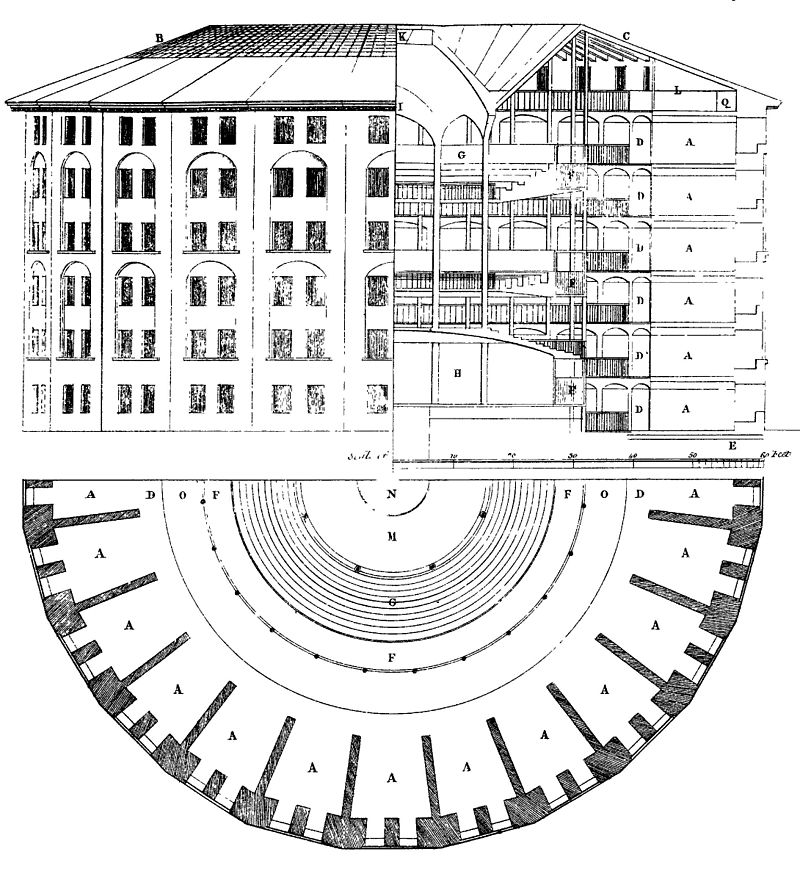
The lecture today on panopticism and institutional power was delivered by Richard. A lot of the lecture was focused on the theorist Michel Foucault, which I believe Richard has mentioned before. Foucault believed in knowledge, and knowledge as a form of power that could be applied. He thought that power has a relationship between people and because of this power could shape and control certain behaviour. This type of idea applied created the technique of 'Panopticism' which is seen in the physical form as a Panopticon. The Panopticon is a type of institutional building that designed by a social theorist and called Jeremy Bentham in the late 18th century. The idea behind the design of the Panopticon is to allow the inmates of an institution to be observed by a single watchman without the inmates being able to tell whether or not they are being watched. So the cells would be arranged in a circular fashion around a watchtower in the centre of them all known as an 'inspection house', which was blacked out so that you couldn't see into it from the position of the cell you were in. The inspection house housed a manager or staff of the institution. Although it is physically impossible for the single watchman that would have been on duty to observe all cells at once, the inmates in the cells cannot know if or when they are being watched means that if they want to avoid punishment the inmates must act as though they are watched at all times, effectively controlling their own behaviour throughout their stay in the prison. Bentham came up with the idea and thought that the basic plan of the circular outer ring, with the figurehead in the centre as being quite easily passed over to create institutions such as hospitals, schools, daycares, and asylums, but most of his efforts were assigned to developing it for a prison, and it is the prison which is most widely understood by the term. He also described the Panopticon as "a new mode of obtaining power of mind over mind, in a quantity hitherto without example', so he thought at the time that his design was the best at controlling the inmates and having the most amount of power over them, even through the fundamental process of having them kept in their cells. The process and design was so strong because for the use of a prison especially, it was an effective way of making sure the bad behaviour of the inmates was kept to a minimum, and there wasn't much interaction between the inmates themselves and the guards or management. The name, despite having roots in 'seeing' (opticon) is also a reference to 'Panoptes' from Greek mythology. He was a giant with lots of eyes, and seen to be a very effective watchman.

Foucault believed that the theory of panopticism was a metaphor for society, specifically how we are always being watched by those in power or by the people with authority, whether it be a teacher or a prison guard. He stated that "the Panopticon is a model of how modern society organises its knowledge, its power, its surveillance of bodies, its training of bodies". A negative side product of Bentham's design is the oppression of people. When control is taken from the hands of the inmates and passed to another, in this case the prison which acts as a form of societal power, then manipulation and exploitation can occur. There is also an issue regarding the privacy of the inmates and their rights in this respect. This issue can also be seen in a modern society, and is often talked about. Often we are unaware of the amount of surveillance we are subject to. For example, CCTV affects us and our behaviour in a similar way to the effect of the Panopticon on the inmates. Though we are told and in many ways we are the beneficiaries of it being put into place, we may act to some extent differently whilst knowing we are being watched. Another example that was given in the lecture of this was in an educational setting. Seats are placed in a way that makes it so the teacher or the person in power can see all of the people attending, and in turn can observe everyone present, this was even evident in the lecture we were sitting in at the time. The arrangement makes it so the people sitting at the front, closer to the person in power could feel more pressured than the people further away to make sure they don't do anything wrong. This is just one example of the theory in practice, the teacher essentially has more control and power based on the way the seats for the students to sit in are organised.

OUAN501 - Identity (5)

In the lecture today we looked at the topic of 'identity'. During the lecture we were shown how popular historical conceptions of identity have changed with time and through different circumstances. Also, stereotypes and to how we as a modern generation in a modern era perceive the state of 'identity'. Finally, how brands and advertising specifically try to challenge it through their use of fashion, design and other forms of visual communication. We also looked briefly into 'physiognomy', which is the assessment of someone's personality or character based on their appearance, this was really quite interesting to me because it's something we all do subconsciously and is almost built into us as a way of evaluating people and what we think of them without ever having spoken to them. This practice was accepted by ancient Greek philosophers but was revived and popularised by a man called Johann Kaspar Lavater from 1775 who was responsible for introducing the idea that this related to specific character traits rather than general types. Furthermore, Cesare Lombroso introduced the theory of anthropological criminology which states that criminal tenancies can be inherited and because of this people who are born criminals can be identified by looking at the physical traits they possess. A person who was born a criminal would have a certain physique, certain facial features, and a lot of tattoos were another feature that he saw as prominent to being a criminal, obviously you aren't born with these however. Though at the time they were conducted these were serious studies, if these were conducted today these would be classed as stereotyping and would hold no academic or scientific merit.

There is a big difference between the historical use of identity and how identity is viewed today, especially in the digital world we live in. We looked at the different phases of identity, these being Pre-modern, Modern and Post-modern. The pre-modern position on identity is one which suggest that personal identity is stable and heavily defined by long standing roles including things like marriage, the church and work whereas modern and post-modern views suggest that you are able to choose your identity and that it is constructed out of the discourses that are available to you. Identity was born when when ancient Greek philosophers introduced the idea of physiognomy. This was an idea that you could study the appearance of a person's face, and judge their personal characteristics or personality traits off these aspects. So, one example was that if your forehead was exactly parallel to your chin, you were a highly intellectual being or very intelligent. The way these traits were looked into however meant that if you held certain genetic traits in terms of your physical appearance it would mean that certain negative or positive attributes could be given to you based on the way you looked. This type of study continued to reappear throughout history but by today's standards it is unheard of, and we would class this type of labelling and allocating characteristics based on physical appearance stereotyping.

In a variety of different industries and practices today, the idea of a stereotype is challenged and we were given some examples of these in the lecture. For example, in fashion. Vivienne Westwood's 'Anglomania' collection used a range of opposing ideas in both the visual sense, using the collection and the ideas used through naming things. So, Tartan is mostly associated with Scotland, however her collection was called 'Anglomania' and using the word 'Anglo' suggests you're from England. This creates a separation in the stereotype of Tartan being used in Scotland and naming the collection after a place that isn't Scotland. In terms of the design industry, Jonathon Barnbrook created the 'Bastard' typeface in 1990. The way that the lettering is composed and the characteristics is possesses with a type of thick boldness resembles that of the Nazi propaganda typefaces that were used in the 1930's. There are also no curves in the typeface, and is quite simple in this sense - and due to the fact it is an exploration of 'blackletter', there is an association/stereotype of Nazi Germany and fascism. Another good example of this that we were shown during the lecture is Tracey Emin's "Everyone I Have Ever Slept With (1963-1995)". For this piece she created a tent that was lined with names of people she had slept with, and it is often misinterpreted as being the names of all of the sexual partners she has had. Without looking further into it the piece can easily be taken at face value, and because of the nature of who she is and what she does you would assume it's a piece to provoke people and allow them to think it has this meaning. Only a few of the names mentioned in the tent she are her past or current sexual partners and the rest are a collection of family and friends and people she had shared a bed with, or fallen asleep beside, leading to an interesting revelation to the audience.

OUAN501 - The Flipped Classroom (3)

This lecture was delivered by Richard on the subject of 'the flipped classroom'. It was apparent that this was a topic he knew a lot about and felt strongly about from the start. 'The Flipped Classroom' is a model of teaching that focuses on allowing the student to essentially take charge of their own learning. The difference between this approach and other traditional teaching models is that the student is the centre of the model rather than the teacher. This in turn allows the students to explore and develop their own answers to their own questions. The flipped model allows for students to explore topics they are interested in or just that they are unsure about or want to know more about in greater depth as the conversation flows more as a debate is not being controlled or dictated by a teacher. This model can create a more personal and overall engaged learning experience for the students and the teacher will be there to deliver content that the students can use how they want to. After looking up this further I found that the flipped classroom is also seen as a strategy and a type of blended learning using instructional content, often online, and sometimes outside of the classroom. It also moves the traditional format of things like homework into the classroom. In a flipped classroom, students watch online lectures, collaborate in online discussions, or carry out research at home and engage in concepts in the classroom with the guidance of the instructor. Perhaps this model is also made possibly by the era we live in, as some of the teaching methods rely heavily on the internet and other tools that have been developed in the past few decades.

'The Flipped Classroom' is a philosophical model of education that eliminates authoritative and subservient ideas, making students in charge of their own learning as well as being able to think for themselves, in a creative manner.


A portion of the lecture was focused on a book that Richard introduced us to titled 'The Ignorant Schoolmaster' by Jacques Rancieres. The book referred to something called 'intellectual emancipation', which is by definition 'the fact or process of being set free from legal, social, or political restrictions; liberation.' It was written in the context of the revolutionary rupture in France 1968 where a student led protest and retaliation fought against the prevailing social order. Eventually, this transformed into a more widespread movement where strikes and workers united. Together they were fighting against the culture of the University which was largely perceived as elitist with a patriarchal bias. Richard told us about an analogy by Rancieres in which he retells the story of a French teacher called Joseph Jacotot who was exiled to Holland in 1818. Jacotot could only speak French and his pupils could only speak Flemish, meaning he couldn't teach them in their own language, or communicate with them verbally. Jacotot obtained two copies of the book 'Telemaque' of that was in French and the other in the Flemish language that the students spoke. He then told the students to learn French. Not long after, the students could make out a lot of the French from the book and understood the meaning of the book without the teacher having taught them directly. The analogy was his example of 'intellectual emancipation' and in turn raises a question about whether teaches are necessary for students to learn. I don't think it's as black and white has having a teacher or not having one, but perhaps this illustrates the idea that teachers don't need to have as much influence on the students learning as they often do - and it could potentially be more beneficial to step back and allow the students to learn amongst themselves or on their own. In conjunction with this, Jacques Rancieres also stated that when a teacher is giving a lesson and giving the students answers, the teacher is not helping the student, or at least as much as they could. As oppose to this they are bringing them into a false sense of reliability, so the pupils are not thinking for themselves, and those who memorise the information given to them will be deemed the more intelligent students in the class.

Jacques Rancieres suggested that everyone is of equal intelligence, in 'The Ignorant Schoolmaster', specifically the chapter 'Reason Between Equals' he says that we are all capable and all fundamentally the same. He asks the question, 'what kind of society could you build is you assume everyone is intelligent?'. Education is not about individualisation, it is a common pursuit and do to the way society is, and revolves around capitalism we are built on divisions - separating people in different ways, such as class, race, and perceived levels of intelligence.

Overall, I found the introduction to this topic quite interesting and found myself reading up on it more afterwards. The topic of intellectual emancipation is something that can be looked at in a variety of ways. For example, I've often thought through school that a lot of what I was learning relied on being able to remember certain things rather than develop and learn as an individual, just as Jacques Rancieres suggested when he spoke about teachers giving students answers and not helping them, instead bringing them into a false sense of reliability.

OUAN501 - Research & Epistemology (2)


"Research is to see what everyone else has seen and to think what nobody else has thought".


The first lecture of the year was conducted by Fred with the title, 'Research and Epistemology'. From my understanding, epistemology is a core area of philosophy and is essentially centred around the limitations of knowledge. The lecture itself I think was a way of making us think about the way we research and learn about areas, with a focus on the creative field and more specifically our own creative practice. Furthermore the lecture looked at the different processes that we work through in order to learn and obtain certain pieces of knowledge. Research to me has always meant finding out information about specific areas which in turn can then be used and applied to other areas, or whatever you want to use the information for. However, we were told during the lecture that the information discovered through the process of researching is useless unless it is transformed into something that can be meaningful to you. To follow on from this, it was said that research itself is also quite subjective. The reason for this is that ultimately everyone has a unique view of different things and thus approaching information will be done so based on the individual, in terms of how they approach and interpret the information through research. This means that by understanding the information that exists and you've obtained it can be approached in a way unique to yourself. There are a lot of different ways of conducting research. Some of the more popular methods, especially for students include visiting the library and using books as a form of research. As well as conducting surveys and experiments. Despite this, different forms of research yield different forms of information and data. The four main 'types' of data that can be produced are primary, secondary, quantitative and qualitative. Primary and secondary data are names for the type source in which the data was received, for example, if it is primary it means that the data was collected but doesn't yet exist. However, if it is secondary the data has already been collected. A way this type of research could be obtained is by looking at previous experiments or finding out about other data that has been collected. Quantitative and qualitative data refers to the type of data that is being collected. Quantitative is data that can be measured, so numbers or facts and statistics. Qualitative is more subjective in this sense and is data that relies on people's beliefs or opinions, so I suppose this could infer a survey, as that can be a method of recording people's attitudes and opinions.

There are also three approaches to research, the first being stimulated research. This encompasses your surroundings and drawing inspiration from different sources within it whether it be libraries, media, or past conversations you've been involved in. The second approach is a systematic approach. A systematic approach is in a sense, experimental, and it allows you to structure and restructure components and characteristics until you gain a solid understanding. Finally, the last approach is internal. This is the development of your own personal thought process based on individual internal perceptions and ideas. This one is important because it can drastically dictate the way you approach a research task, and research in general. Something else that Fred said that stuck with me was when he spoke to us in terms of creative practice and research in that sense, it can also refer to learning new processes, and experimentation that can be conducted in order to find out what may work and what won't. He also said that it is good to embrace failure. The reason for this which made quite a lot of sense to me is that it will strengthen the knowledge for what will work in the future, essentially learning from mistakes and in turn not succeeding straight away but in the process of problem solving and experimentation learning several outcomes and finding out more than just the right way of doing something.

Overall, research will more or less be unique to the individual conducting the research because when people research things their goal is to discover or learn about things that they don't already know about, essentially putting them at the centre of the research. This is due to the fact that the type of research conducted and the manner in which it is conducted revolves around what prior knowledge they do and don't already have. A lesson that the lecture taught me is that one of the most important things to remember is to make sure research is relevant to our own practice and to gather and process it in a way where we can understand it, or use it to further our knowledge and gain experience.

OUAN501 - Lecture Program (1)

Today we were given a brief overview of the lecture program for level 5, although the titles of the lectures were quite ambiguous, I'm looking forward to them. As well as this we went over the assessment criteria and what constitutes the passing requirements for the context of practice module. One thing I do want to do this year is take the material from the lecture and attempt to research into it further in order to obtain a greater understanding of the subject. Hopefully in turn it will allow me to develop my knowledge of the different areas quite well, and become a greater practitioner for it.

Thursday, 22 October 2015

OUAN501 - Seminar, Animation & Authorship

This was the first COP seminar we have had this year, and the theme that underpinned our discussion for the duration was the idea of 'Authorship'. We were reminded about the idea of an auteur which I was personally quite familiar with and am also interested in, which is shown in my choice of essay during last year which was based on auteur theory and the avant garde. It was touched on towards the beginning of the seminar and the example that was given to us was in terms of film, so directors can have recurring themes, genres and visual choices that recur throughout their work, which in turn allocates them a dedicated style that is often seen in films they direct. The way this is achieved means that they become an artist in their own right, due to the control they have over the direction the film takes and essentially dictate the artistic choices for the final cut or have the final say. During the seminar we also watched an interesting 'Daffy Duck' episode which the title 'Duck Amuck' which sort of parodied Hollywood during the 50's when this piece was originally created, so there was some interesting representation of ideas featured within it. Finally, we looked closely at 'The Death of the Author' by Roland Barthes, which was very interesting and was a type of lecture I've never had before, overall we looked at the text, tried to deconstruct it and discussed various themes before relating it to animation and how it could apply here.

In short, I believe that the general premise of the text by Roland Barthes is that the reader is free to interpret, and understand a piece of writing by removing the author from the picture and examining that piece of writing for what it is when trying to pursue what they believe to be the meaning of a particular piece of writing, and thus come to conclusions and draw ideas from it. 'The meaning of the word ‘author’ has shifted significantly through history and has been the subject of intense scrutiny over the last 40 years.' (Rock, M., 1996) The Death of the Author begins by Barthes discussing an extract from Sarrasine Balzac's work where he is describing a castrato, disguised as a woman. Barthes then questions who it is that is describing or narrating the story, whether or not it's the character within the story, or the author himself, "Who is speaking thus? Is it the hero of the story bent on remaining ignorant of the castrato hidden beneath the woman? Is it Balzac the individual, furnished by his personal experience with a philosophy of woman?..." (Barthes, 1968) He goes on listing a few other possibilities and comes to the conclusion that we will never know, due to the way that writing is simply the recycling of ideas and that there is no originality as all writers do is draw upon pre-exisiting ideas. From this he starts to mention how he believes the author or authors are given too much credit for the language used in their writing, and in reality it's the writing that shapes the authors piece and how they write a specific style or cover various themes and genres.

It's in the second section of the extract that Barthes touches on this again but from a different angle, "The sense of phenomenon, however, has varied: in ethno-graphic societies the responsibility for a narrative is never assumed by a person but by a mediator, shaman or relator whose 'performance' the mastery of the narrative code may possibly be admired but never his 'genius'. The author is a modern figure, a product of our society insofar as, emerging from the middle ages with English empiricism..." (Barthes, 1968) This particular quote has an interesting social implication in relation to the point that Barthes is trying to make. The way he speaks about the author being a 'product of society' implies that like any other person, he is influenced by society through political movements, social and cultural changes along with trends the things that society is doing and investing in affects an individual within a society whether they are aware of it or not. An example of this lies within genre, so if a book is released with the horror label attributed to it then consumers will already have a kind of pre-existing view or feeling towards the book based on their feelings of the horror genre itself, this kind of example is especially relevant in a capitalist society where consumers are constantly being bombarded with material and products based on trends and preferences. According to Barthes in this section, I believe he once again refers back to the idea that the author is often manipulated in a sense by their surroundings and utilises common knowledge and common methods in order to produce writing, and not always in a conscious way. However, it's important to realise that as individuals with our own set of preferences and ideologies each person will interpret something like a piece of writing differently.

"Van Gogh's his madness, Tchaikovsky's his vice. The explanation of a work is always sought in the man or woman who produced it, as if it were always in the end, through the more or less transparent allegory of the function, the voice of a single person, the author 'confiding' in us." (Barthes, 1968) This section is Barthes saying how people relate an artists 'madness' to their work even when it can be completely unrelated, as if people or critics for example try to look for meanings when more often than not there's no real reasoning behind something. Or, at least the artist or creators intention was not as complicated as someone is trying to make out. Ultimately what's being said here with Van Gogh as an example is that despite the artists intentions the viewer of the work will always be free to relate certain aspects of work to something about them, so again, various aspects of Van Gogh's work are are said to be the result of some of the actions that throughout his life, such as dismembering his ear - which could be interpreted as an act of madness.

Barthes, R. (1977[1968]) 'Image, Music, Text', London, Fontana Press.
Rock, M. (1996) 'The Designer as Author', Eye no. 20 vol. 5 1996.

Tuesday, 24 March 2015

COP Practical - Process

In order to make the video for my COP practice, I first established the idea for how I was going to shoot it. Previously I thought I would try and do a short narrative that incorporated multiple techniques from the directors I had looked at. However, when thinking about it, I decided it might be too vague on it's own, so instead I decided to shoot bits of footage and then edit them based on the way the directors I'm looking at worked, so show examples of how I have understood their methods and what unique traits they possess within their work.

I went out and shot different footage of buildings, public places and vignettes so that I could create a compilation type feature. Once I had all of the footage I thought was appropriate I edited it together in after effects, making sure the order was appropriate and that the clips I'd selected were relevant to the techniques I wanted to demonstrate. I needed a symmetrical shot, and I found a bridge that had the one point perspective that Kubrick uses, which I thought would work and demonstrate this technique. Other pieces of footage are of random subject matter such as the shot in the park, but is used to potray something that isn't based on a subject, such as lighting or use of tint.

I then worked in after effects to achieve certain elements such as lighting, and adding the text over the top of the video - labelling the footage with it's intention and what it demonstrated. The sound design for the video was made by my friend, who was experimenting with ambient type sounds. In several of David Fincher's films he uses composers, Trent Reznor and Atticus Ross to produce the score. The score they produced is quite an experimental ambient sounding one, and I thought that since a lot of the video features examples of David Fincher's style, it would be appropriate to use this type of sound. I used premiere pro to edit and trim the sound, whilst transitioning it together. Problems did arise when some of the sound clips sampling frequency was 44100Hz, as oppose to others which were 48000Hz. To make them the same, so that the sound could be exported, I took some of the sound clips into audacity and changed them so they were 48000 also.


COP Practical - Auteur Theory

My COP essay is based on the idea of auteur theory and applying that to animation. The concept is not something I have previously looked at but I have found is quite fascinating from doing research around the stop. Throughout my essay I referenced various aspects of film making that can also be applied to animation such as the use of cameras, lighting, themes and overall direction. As examples I used various directors whose work I'm familiar with in order to reference the way they were and are used by established directors. The directors I referenced specifically during my essay and that I have looked at for research purposes are; Stanley Kubrick, David Fincher, Alfred Hitchcock and Wes Anderson.

Each directors I looked at had a certain method or style that I could reference and look at in closer detail. Whether that was the low key lighting that Fincher uses repeatedly throughout his work to depict a level of unease and grime that is representative of the dark themes that run through his films; the use of symmetry that is often seen in scenes throughout Kubrick's work; or the colours and aspect ratios that Wes Anderson uses to make his films have a very particular visual style.

My idea for the practical side of the brief is that I would like to create a series of vignettes or samples of action where I can incorporate the techniques and hopefully to an extent emulate the visual style of several directors to show I have examined and absorbed in a sense, their individual artistic direction. The video will be between two or three minutes long and split into two sections. The first section will show around seven to eight short clips, each lasting around ten to fifteen seconds looking at a particular technique or notable way that one of the chosen directors portrays the visuals in their films. The second half of the video will repeat the same clips, but this time with annotation mentioning the director and the technique that I have attempted to demonstrate.

So far, my ideas for scenes are;

  • A character sat at a desk, featuring a symmetrical shot, similar to that of Kubrick's.
  • A shot of a city scape, wide angle with the low key lighting often seen in Fincher's work.
  • Some imagery depicting self destructive behaviour and overall dark themes, referencing Fincher's themes.
  • A vibrantly coloured scene, representative of the colour in Wes Anderson's films.
  • A scene that plays with aspect ratios, looking at Anderson's use of them. (1.33:1 / 16:9 / 2.35:1)
  • POV shot, used extensively by Kubrick.
  • Dutch tilt, used frequently by director of film and animation, Tim Burton.
  • Mental disorder themes, used by Fincher.
  • Characters you wouldn't find in reality, Tim Burton's work.

Sunday, 22 March 2015

Context of Practice - Politics & Propaganda

Politics and propaganda come hand in hand when talking about them together. The purpose of propaganda is to promote political agendas and in a sense act as a link to the public through visuals presented to them in the form of propaganda. However, seeing this relationship on a deeper more analytical level was interesting and it made me realise the amount of propaganda that existed that I had never heard about.

Something we looked at during the seminar was the use of propaganda, incorporated into the animation medium. Of course, like most people, I was aware of various uses and examples of propaganda during war time, and had encountered it multiple times. But when it came to some of the animations we were shown, I was unaware that they had existed prior to the introduction to them during the seminar. The idea of using animation as a form of propaganda during world war II for example makes sense. The medium was relatively new and considered quite innovative, as well as this it reached out to a broad audience, children included. We looked at an piece of animated propaganda produced by Disney in 1943, Der Fuehrer's Face. The piece itself was quite interesting as it had a very extreme themes in it, or what I would consider extreme by today's standards. I imagine based on the fact that it is an animation produced by Disney that the main target audience for it was children, at the time of course, people probably recognised the fact that it was propaganda atleast that it was aimed to tell a story based around Hitler and how 'evil' he was.

After this, we watched several other pieces that were made to act as propaganda and persuade audiences to adapt to a political regime. The topics they cover of course, would have been much more intense and relevant at the time they were shown, whereas now we are watching them many years later, they are quite clearly propaganda and make no effort to disguise this. Overall they would have had a much different effect at the time. This is the same for all propaganda though, during the time of its release it's relevant and seamless, whereas years later when political regimes change, you notice how bias and manipulative it's trying to be.

Context of Practice - Auteurship and the Avante-Garde

I found the context of practice seminar on auteurship very interesting because this was the first time I had been introduced to the concept and I found the idea of it very new and intriguing. Essentially, auteur theory, (‘auteur’ being the French word for ‘author’) is a concept that suggests a director in terms of cinema, has a collection of work where there is similar themes and visual choices throughout. These choices can be chosen for specific reasons or can occur naturally through the unconscious decision of the filmmaker. Auteur theory originated in France in the late 1940s and was a foundation for the French cinema movement that was dubbed, ‘nouvelle vague’ or, ‘new wave’. The idea driving the concept is that it is the director who looks over and approves certain elements of a motion picture and thus deserves the title “author” as oppose to the writer of the screenplay for example. Certain aspects of the direction and camera work such as the length of the scene, positioning of the camera, and choice of lighting are what makes the film what it is visually. People who agree with this concept often remark on the way that films which are successful often have the directors unmistakable taste and personal choice marked on the film.

After we were introduced to the concept, a discussion took place and people put forward their opinions based on what we had learnt about it. Someone asked the question, 'if another director has the same visual style as another, does that make them both auteurs?' A counter argument to this would be that one of the directors could have taken inspiration from another and consequently the original director, or the one that worked in the specific way first would be classed as the auteur, as one of the factors of auteurship is working in a unique and personal style, rather than emulating others.

From here, the concept was linked to animation and we spoke about how auteurship can be applied to animation. We were told that rarely are animators given the title or called an 'auteur' because of the nature of the medium. By this, I mean so much of the film is based on unique visual ideas that it's hard to call the director the single greatest contributor to the film. When it comes to animation, ideas are picked from thin air and developed as a team, rather than film where you are consistently shooting live actors, and other variables can be altered such as the previously mentioned aspects of camera, lights etc. Despite this, animation like film can have recurring themes, genre and consistent visual styles one the style has been developed. Where a team of people creates the work however, it could be dubbed, 'avante-garde' as oppose to auteurship, as it is original and new, but just lacks the individual flair that has to exist to call something a product of auteurship.

The idea of 'avante-gardism' implies that the work is a product of rebellion agains the norm, or going against the expected. It is also associated with innovative work, and moving forward. When looking at a large cooperation such as Disney, who were one of the pioneers in animation, at the start of their work they would have been considered avante-garde, where as now their work is established and lesser known upcoming animation studios developing new styles and practices are more inclined to be referred to as avante-garde.

I found this seminar extremely interesting, and I liked the introduction of a new concept I hadn't had the opportunity to learn about before this. To understand the concept in detail would be quite complicated I feel but given the time we had I feel like I have a firm grasp on the idea and what it means to be an auteur.

Context of Practice - Genre

The word genre has quite an extensive meaning, but simply put it is defining categories of literature or other forms of entertainment for example, music, visual entertainment or written or spoken; that carries some form of stylistic criteria. 'Genres' are formed by conventions and ideas that adapt and change over time as new genres are introduced or invented and other genres are discontinued. Due to this ever changing principle, more often than not, works will fit into multiple genres because of the breadth of criteria and features it possesses.

An example of this kind of multi-genre idea in animation is a piece that is directed at children due to the visuals and appropriateness of the content, however, it will have adult undertones running throughout it whether it is conveyed through subtle on-screen action or dialogue between characters. This action or dialogue won't be picked up by the younger audiences, although the more mature audience will recognise the references due to their wider knowledge of the world. So in a sense, this is an example of a piece that will stretch across multiple genres and can be enjoyed by various different types of audiences. An example of this shown to us during the seminar was a piece featuring the Looney Tunes character, 'Yosemite Sam'. During the piece, there was a reference to Mahatma Gandhi. Even the first time watching it before it was made clear to us, I didn't pick up on the reference because I was too immersed in the visuals to notice. Demonstrating the idea that references contained within an animation mainly aimed at children, can also feature adult content without being destructive to the piece itself.

Following on from this, as a class we had a discussion about the purpose of genre and what it does. The point was raised that certain pieces of entertainment are marketed differently in order to aim the feature at a certain audience. An example of this in industry was the film; The Hunger Games. The example here is that the film was originally planned to be marketed as a science fiction film, but it was changed by the distributor to a fantasy type film because fantasy doesn't have the stigma attached to it that science fiction does in terms of previous films such as Star Wars which is a well known science fiction film and has very mixed opinions across a large audience. So because the fantasy genre is much more well received by audiences of all ages and gender etc, it was put forward this way to be more successful. In a way however, I believe this to have been bad practice. Genre isn't really a subjective thing as the point of genre is to have a set criteria in order to categorise certain products or works.

Giving products and work a genre to go under can be very helpful however. It gives audiences a hint about the content of various products and entertainment, allowing them to make informed decisions about their interests and what kind of activities they wish to pursue. One thing however, is due to the rate at which things like entertainment evolve and change, it is often difficult to keep up and content can be misinterpreted or labelled incorrectly by individuals because of this.

I enjoyed this seminar quite a lot, and the discussion made me think quite a lot into the subject. Furthermore, it was interesting to talk about different classifications of entertainment and how that can affect different peoples perceptions on what to expect and the overall content of a piece.

Saturday, 21 March 2015

Comparing The Hand by Jiri Trnka & Surogat by Dusan Vokotic

I will be comparing the two animations; 'The Hand', by Jiri Trnka and 'Surogat' by Dusan Vokotic.

Firstly, after watching the hand I got a feeling of uneasiness because of the lack of colour and sound in the animation, however I think that is the kind of impression it was intended to give. It's also noticeable that there is no dialogue in the animation, so it's a fully visual experience. I believe that the purpose of the animation was to signify the oppression of creative freedom. There is a highly political presence when looking at the themes and message concealed within the visuals. For example, the main character who is a potter, is approached and harassed by a hand. The hand being a metaphor for a political party or government, he is asked to create a sculpture of the hand, but he resists, just wanting to be left alone with is friend which happens to be a potted plant. The hand uses bribery before demanding and threatening the main character and he becomes more desperate to escape it. Eventually the hand locks him up, and forces him to sculpt it whilst caged up. Something I liked about this scene was the use of puppet strings to control the character to represent the idea being controlled by the hand or a more powerful being in terms of political standing. After the character breaks free and escapes the clutches of the hand, he runs back to his home and tries to lock himself in, accidentally knocking his plant pot off a ledge and killing himself. The final scenes are the tragic visuals of the characters funeral.

The sound design is very minimal for this particular animation, but I like that when the sound does come in it's quite a shocking experience since it has been quiet for most of the duration. As well as this the sound comes in at a pivotal moment in the animation and this signifies this. The colours used are dull and washed out, so you know straight away that the themes of the animation are quite serious. The emptiness this adds is also key at making you feel quite depressed throughout the animation, even more so when the story unravels on screen. Finally there is a good use of camera shots throughout the animation and the story is very clearly told in this respect; an appropriate mixture close up and wide shots is also used. Throughout the animation there is a type of high angle shot used that is always looking slightly downward on the character, as if he is of a lesser power to the hand. This could also be some form of representation of the fact that in the context of the narrative and animation, he is quite insignificant despite being the main character whilst making the audience feel inferior to empathise with the character. Whenever the character opens the doors are windows to his house, all we see as the audience is blackness, as if his house is situated in a void or an abyss. This kind of unknowing as to what lies beyond the walls of his house gives way to the idea of voyeurism, or some form of intrusiveness, in collaboration with the visuals on screen where the hand is repeatedly breaking into his home.

The type of political influence that I mentioned earlier that is featured in the film is representative of totalitarianism. Meaning; 'a political system in which the state holds total authority over the society and seeks to control all aspects of public and private life wherever possible.' This backs up the theory that the hand acts as a motif for this political aspect to the narrative, and the character represents an artist, more specifically a potter that is being oppressed by the government due to the regime they have put into effect.

The second film we watched, is Surogat by Dusan Vokotic. Visually, compared with The Hand the aesthetic is considerably more light hearted due to the simple shapes used to represent characters and the environment in combination with the vibrant colours. However, the subject matter remains quite serious or controversial similar to The Hand. The setting of the animation is a beach, and all of the objects featured within the animation are inflatable.

One of the main differences I noticed between this animation and the other whilst watching them, aside from the visuals and medium, was the use of humour and easy going nature of the whole feature. There was an element of slapstick comedy to it. An example of this is when the female character slaps the male character and his face goes bright red in reaction, he immediately runs over to the sea and puts his head in to 'cool off' as if it was a burn. Beneath the humour and light heartedness of some of the scenes in the animation, there is a deeper message for the audience in that despite the material possessions and idealistic views the character obtains throughout the duration, he can't change who he is. Eventually, despite his efforts it all comes crashing down on him and he dissipates from existence when his inflatable car explodes. Aside from this, it comes across like there is a certain element of sexism in the film, as he tries to modify the body of the female character to suit his ideals once again. It's quite tongue in cheek but I think if this film was released in a modern era as oppose to the 1960's it would have received a more critical response from the audience, or at least have been looked into more critically from this angle.

Overall, both animations; The Hand and Surogat, carry important and sensitive messages in their own way. One is about the then current state of the government, touching on it's regime and essentially acted a metaphor for their ideals. Whereas the other looked at the ideas of a man in the 1960's, material objects being of high importance and the objectification of women to an extent. Visually, Surogat is a lot more playful, whereas The Hand has a very eerie and dark aesthetic that makes you take it a lot more seriously as a stand alone piece. The animations themselves were different than anything I had ever seen before and I was glad I got to look into them both in detail. Finally, I engaged well with the subject matter and found the different implications of subtle aspects quite fascinating to deconstruct whilst comparing the two.


Context of Practice - Seminar 1

This context of practice seminar was related to putting things into context, and identifying the context of art and more specifically, animations place as an art form. The general idea of something, whatever it is, having a context is; 'why is it the way it is?'. There are a huge number of variables that could have potentially influenced or had an effect on someone and something that in turn manufactured a certain piece of art. These can be anything from historical, social, political or even economical contexts that have in turn shaped and crafted a piece of art due to the circumstances when a certain piece of art was crafted. There is a great and hidden importance disguised in art and knowing, 'why it is the way it is'. I think it's important for people to think about, discuss and reflect truer meanings that artists have and have had behind their work, in order to not only understand the artist and their artwork but the influences and contexts of the time it was created.


Looking at this further, as a class we were shown two images. The first image, depicted the cover of time magazine, which featured a photograph of the world trade center exploding on the 11th September, 2001. When this image first came on the screen, I instantly identified what it was and a flood of memories and connotations of the image came into my head. We were then asked our opinion on the image, and if we remember what we were doing on the day it occurred since most of us were only around six or seven when it happened. From here, the general discussion shifted to the idea of this event being a conspiracy. I have seen several documentaries that put forward ideas about the attacks being a conspiracy and had some thoughts on this myself, that I was reviewing whilst people were putting their opinions forward verbally during the discussion.


After being introduced to this hard hitting image of one of the most famous 'terrorist' attacks in history, often dubbed, 'the day that changed the world'. We were shown a much more light hearted image of a CD cover, which in composition was actually quite similar to that of the Time Magazine cover, but with an interesting twist. What was interesting is that people's reactions, mine included to this image were not only how ridiculous and laughable it was as a whole, but a little bit concerned as to how offensive it was or could be, not necessarily to us, but to people who have been directly affected by the September the 11th attacks. It was then revealed after a few minutes of discussion about the image and how bad the overall design was, that it was released around a month prior to September 2001. Changing ideas and the general context of the image completely. I almost felt a little bad for the people who had released the CD because it would obviously have to be withdrawn from public view, out of fear of causing offence and consequently causing a bad name for themselves. I think the purpose of this exercise was to demonstrate the important of context and knowing facts before you put forward extreme views and judgments based on a piece of art work or design. I enjoyed this seminar quite a lot due to the way it made us think and overall how thought provoking it was. The revelation about the CD cover in connection to the terrorist attack was quite eye-opening and definitely made me think about how much I knew about it before I judged it.

Monday, 26 January 2015

Post-modernism

I enjoyed attending this lecture for the same reasons as the modernism lecture in that it gives insight into not only the art and design world but has information on social and political influences that are surrounding the movement. Aside from this I find the subject itself fascinating because of how hard it is to define within itself but it just kind of has things attached to it. The movement originated in the late 20th century and is a departure from modernism in terms of art, architecture and philosophy. The movement as a whole is considered a revival of historical elements and techniques.

The lecture also spoke about Jean Baudrillard, who has a very high level of influence when it comes to post modernism and its ideas. I think it was also mentioned in the lecture that he has written essays on the subject. In order to understand more about post-modernism its quite important to read his work and try to understand the theories he writes about. Out of all of his work, he has two main points that are important from an artistic perspective. Firstly he was written extensively about the world around us and how our ability to perceive it changes as we are influenced by the media. He has come to the conclusion that we almost live in a hyper reality, where the amount of entertainment and materials we consume such as film, television and video games have altered our perception of reality and changed the way we communicate. The other fundamental idea he has is that we give ourselves up to communication, and we are under the power of this form of mass media that was mentioned previously; film, television, video games. He also thinks we are doing this subconsciously and can't control it because of the amount of it we encounter in our daily lives.

Following on from this, Jean Baudrillard states that we connect with celebrities and fictional characters on a deep level, giving them more prestige and acclaim then they should have or that they deserve. Finally, he said that we get nervous when we are away from our phones or the internet for too long. "We have entered an era where third-order simulacra dominate our lives where the image has lost any connection to the real thing".

Modernism

I thought this lecture was interesting because it had a lot of social, political and historical topics incorporated into it as well as the discussion based on modernism itself. Modernism is a philosophical movement combined with cultural trends that appeared in Western society in the late 19th and early 20th centuries. We learnt about various different topics throughout the lecture and it appears that the word Modernism has a number of different connotations and meanings.

  • Modernity, Industrialisation, Urbanisation
  • Modern artists
  • Psychology and subjective experience
  • Modern art and photography
  • Modernism in design


A lot of what was talked about referenced France and Paris in particular. In terms of art, artists at the time started focusing less on people and using them as subjects, but rather focusing on their environment and the setting they were in. This was to highlight the social changes within society, and to try and capture the ever evolving society that they were based in. By capturing the environment around them, artists were subconscious capturing aspects of society such as the difference in wealth across various people. This kind of detail was captured by artists paining clothes and of people featured in their work as well as other subtle details such as who owned a vehicle, which were incredibly rare at the time, and the types of places different people would visit or be able to afford. In terms of relating these ideas back to present day, trends happen all the time, whether it's fashion or food, or decoration. We all notice it and are consciously aware of the movement and forwarding of these aspects, but on the most part society accepts them and embraces them.

Overall the modernism movement is about moving forward and being conscious of changes within society and amongst people. But more importantly, to be accepting of the changes. I think this movement is also based around free thinking and expression. This is complimented by the fact that during the early 20th century when modernism was emerging, a lot of modernists rejected things such as religious, which was heavily considered a fundamental value at the time.

Chronologies 7 - Animation

This chronologies lecture was of particular interest to me as it provided a brief history of the course I'm studying on, as well as giving me insight into various animations I had never heard of or seen before. Despite it being a brief history, it covered a huge amount of content, and a lot of videos were shown or recommended to us so that we have a lot to go away and watch afterwards. The lecture had another practical use as all of the historical work it showed us could be used as research and reference when pursuing future projects.

The beginning of the lecture was focused on the origins of the idea of animation, and how the word 'animation' came into existence. The word animation is derived from the word animare, meaning "to give life to". We were then told about the basics of animation to cater for the people who hadn't yet been introduced to various concepts, this included the idea that animation is a series of images played in sequence and about the illusion of movement. We were taken through almost like a timeline about the most basic forms of animation that were created after the magic lantern in the 19th century such as, the Thaumatrope, the Phenakistoscope and the Zoetrope. From here we were shown information about the flip book and early forms of projection.

We were then given a real chronology of animation, starting in the year 1900 and leading all the way up to the digital age starting in around 1985. It was really interesting seeing the development of animation in the form of a timeline, and it was useful to see how certain movements and techniques that had been discovered and utilised inspired other works. One of the most important eras we were shown was the Golden Age of Cartoons. It became clear to me how important this era was in terms of animation as well as everything else because of the events that happened during that time. For example, there is a huge amount of political and propaganda animation in this period such as Disney's animations based on Hitler. As well as this innovative and brilliant animated works that are still popular today such as Fantasia and Snow White. This was also a time for experimentation, and pushing the boundaries of animation, not just in terms of the technical boundaries or visuals, but in terms of the content and narratives that could be shown publicly. More specifically on the golden age of American animation.'The Golden Age of American Animation', was a period in the history of U.S animation that began in 1928 with sound cartoons and continued until 1960 when theatrical shorts began to fall short to the new medium of television animation, which was becoming popular. During this period, many popular characters emerged within the animations that were shown such as, Micky Mouse, Bugs Bunny, Popeye and Tom & Jerry. During this golden age period, feature length animation also began. The first of Walt Disney's feature films were produced during this time, including and post notably; Snow White and the Seven Dwarfs, Pinocchio, Fantasia, Dumbo and Bambi. So overall, this was a time for emerging animation, and the cartoon industry was thriving in this time, hence the name.


Following the Golden Age of Cartoons there was the television age. This era still featured propaganda and animations that showed sensitive content, such as; The Hand and Surogat that we looked at in detail during our context of practice seminars. During this era, boundaries were still being pushed in all senses. Animators such as; Gordon Murray, Terry Gilliam and Oliver Postgate created popular content to be shown on television. At this point feature length animation films were becoming more popular and seen more frequently, releases such as British feature animations, Watership Down and the American release of A Christmas Carol were proven to be popular also.


From here, the digital age of animation began opening an unlimited number of doors for animation and making the industry come alive once again. In Japan films such as Akira being released and being hugely popular around the world in combination with Studios such as Studio Ghibli proved that good animation can come from all over the world and not just the western world. The company pixar was another huge contribution to the progression of digital animation with releases such as Toy Story amongst others becoming hugely popular. The industry has continued to grow up until this point, and animation is seen everywhere from music videos, to feature films and advertising.


Overall, as an animation student I found this lecture incredibly useful and also very interesting. I learnt a huge amount about the development of animation over the course of a century and can use what I've learnt to influence my own work in the future.

Chronologies 6 - Photography

I was looking forward to this lecture quite a lot, as photography itself is something that I enjoy a lot outside of studies, and I try to incorporate it into my work whenever possible. Despite it only being invented in the 19th century, the amount of documentation we have and the amount we know because of it is astounding. It is an incredibly interesting medium, capturing a moment in time, a fraction of a second that will be preserved for virtually forever. It is estimated that since the invention of photography, over 3.5 trillion photographs have been taken. That is a huge amount of documentation, and today with the ease of access to digital cameras, with almost all mobiles phones having one built in, it's no surprise that this number is growing at an extreme rate. Photographs have an infinite number of uses; some of the more practical uses are things such as evidence, documentation, advertising, design, art, forensics and commercial use.

Photography can also be used in controversial ways. Documenting or photographing sensitive subject matter and showing it publicly can be upsetting to some people, and there is certain restrictions on the type of material that can be shown to a universal audience. Photography depicting graphic or grisly images and nudity for example have certain restrictions on them depending on their purpose.

Throughout the photograph presentation we were shown a number of photographs of historic events or what we consider now very interesting documentation of various people, locations or just an interesting subject matter. The ability to see history in images is something that you don't think about until your attention is brought to it. The subjects of the photographs at the time, would have thought nothing of it, but being able to see people going about their day over a hundred years ago is really something incredible when you think about it. However, photographs aren't always what they seem. with the movement and development of technology, photo editing software has become more available both in industry and for personal use. This means that photographs can be altered in a variety of ways, and this can be dangerous for various reasons. Firstly, photographs that are used for things such as evidence or documentation can be altered to be misleading or false, which could cause serious repercussions. Secondly, in more recent years the way people are represented in the media has been criticised due to the manipulation of photographs of people to the point where their bodies and faces look different to what they actually are. Meaning society is constantly being bombarded with unrealistic and unnatural representations of people that are simply modified versions of their real selves. So, unfortunately like everything, photography and the way it's used has it's complications.

Overall, this was an incredibly insightful lecture, not just looking at photographs and their uses through history. But a look into history itself at some key events, which was interesting on its own. Furthermore, it reinforced to me how powerful photography is and what a versatile tool it is in the modern era. Given the ease of access in modern society, I feel incredibly fortunate to be able to use it as freely as I am.

~

Chronologies 5 - Advertising

I wasn't able to attend the Advertising lecture because we were at Bradford Animation Festival that week. However, when looking back through the lecture notes on eStudio, the question on the first slide was; Is Advertising Prostitution? However, I find advertising an interesting topic to learn about and it coincides well with some of the previous lectures such as Communication & Mass Media and The History of Print.

Whilst looking through the slides of the presentation I cam across one that read, 'Does sex actually sell?'I linked this back to the idea about advertising being comparative to prostitution and it made more sense. Branding or advertising often includes people with model status to brand and advertise various products, and there are multiple examples of products, from perfume to clothing items and even food that are depicted in what could be considered a 'sexual' way, with the exposed bodies of various people as a focal point. I suppose in this way, 'sex' does sell. Using sexual connotations as a method of branding and as an advertising tool has been a growing practice for decades. It's now at the point where most of us see an advert or a billboard advertisement of that nature, and don't think twice about it because it's such a common practice.

One of the slides also puts forward the idea that advertising is a capitalist tool that is used to change the values of society. Which to an extent is correct. In a way it works both ways, as society changes its values so does advertising and it adapts the way the advert is designed to societies values and way of thinking. On the other hand, the way advertising is done can also change the values of society, like a vicious cycle of continually changing values and trends. Furthermore, the way advertising can operate, especially in a modern society where people care more and more about social status, and their place amongst and in relation to everyone else; advertising can be quite influential and change individual peoples perceptions when it comes to making them think, and behave in a certain way.

Relating back to the question that was raised at the beginning; Is Advertising Prostitution? The idea of sex is often used to sell products to the general population because in modern society it has such a big influence. This may not necessarily be a bad thing, but it can change societies perception of reality to an extent and perhaps change its values. However, advertising can also be a positive influence. At this point, some adverts are very enjoyable to watch and companies go to extreme lengths to produce interesting and well made adverts. Finally, advertising is an extremely powerful tool and has the potential to manipulate society through various means, so it's important to keep this in mind, and think for yourself when considering some of the ideas it portrays through advertising in the media.

Communication & The Mass Media

The idea of the term Mass Media is essentially a means of public communication that reaches a large audience. Things that we consider mass media are; radio, television, newspaper and magazines because these are types of communication that reach large portions of the population, and a large number of people in general.

The technologies that mass media is communicate through varies greatly depending on what it is. For example, broadcast information though mediums such as radio, television, film and recorded music is communicated electronically using the electromagnetic spectrum, or more specifically, radio waves using a one-to-many model. In contrast to information communicated this way, print media uses physical copies of objects such as newspaper, magazines, books or pamphlets to distribute to the general population. Furthermore, outdoor media comprises billboards, signs, shops and information posted on transport. In the context of a design school the kind of course you would be studying on to transition into the communication and mass media industry in a visual way would be;

  • Communication Design
  • Visual Communication
  • Graphic Design


During the lecture, we were shown how communication and transmission of information has developed in the past 17,000 years or so. Firstly, we were shown cave painting from around 15,000 to 10,000 BC that was found in France. The image itself was of cattle and horses, and shows even this long ago early humans were documenting and taking note of their environment and surroundings. From here we were shown an image of a painting that was produced around the 14th century on a chapel wall, located in Italy. The interesting thing about this image was that it had a narrative to it and appeared to be showing an event or sequence of events. This kind of documentation allows us to investigate events that happened hundreds or thousands of years ago. Next we looked at a soap advertisement from the 19th century, and in a way the start of graphic design as we know it today. In 1922, William Addison Dwiggins said; ‘In the matter of layout forget art at the start and use horse-sense. The printing-designer’s whole duty is to make a clear presentation of the message - to get the important statements forward and the minor parts placed so that they will not be overlooked. This calls for an exercise of common sense and a faculty for analysis rather than for art.' on the subject of design. In a sense this was the time when graphic design and layout started to be recognised and the importance of conveying the message through design became more relevant. Richard Hollis also said ‘Graphic Design is the business of making or choosing marks and arranging them on a surface to convey an idea.’ Which is a very simplified idea of design or specifically graphic design.


‘Although graphic design as we know it originated in the late nineteenth century as a tool of advertising, any association today with marketing, advertising, or capitalism deeply undermines the graphic designer’s self-image. Graphic design history is an integral part of advertising history, yet in most accounts of graphic design’s origins advertising is virtually denied, or hidden behind more benign words such as “publicity” and “promotion”. This omission not only limits the discourse, but also misrepresents the facts. It is time for graphic design historians, and designers generally, to remove the elitist prejudices that have perpetuated a biased history’.

After looking at the origin of graphic design we were shown some propaganda before looking closer at logos and what they represent. Finally, we were able to look at the communication of messages through campaigns and how those type of advertising campaigns have developed up to modern day.